
• 10 min read
SEDOL Code: The UK Stock Identifier Working Behind Every Trade
Ever wondered how your broker ensures you buy the exact stock you intended, not a similar-sounding security or wrong share class? SEDOL codes prevent these costly mistakes.
What is a SEDOL code?
SEDOL stands for Stock Exchange Daily Official List. It's a seven-character alphanumeric identifier that uniquely identifies securities traded on UK and Irish exchanges.
The London Stock Exchange issues SEDOL codes to distinguish between different securities, share classes, and listings. Every security gets its own unique code.
Here's what makes SEDOL interesting: the same company can have multiple SEDOL codes if it trades on different exchanges. HSBC, for example, has separate SEDOLs for its London, New York, and Hong Kong listings.
Every time you trade UK stocks, SEDOL works invisibly to ensure you buy exactly what you intended.
Want to verify if a SEDOL code is valid?
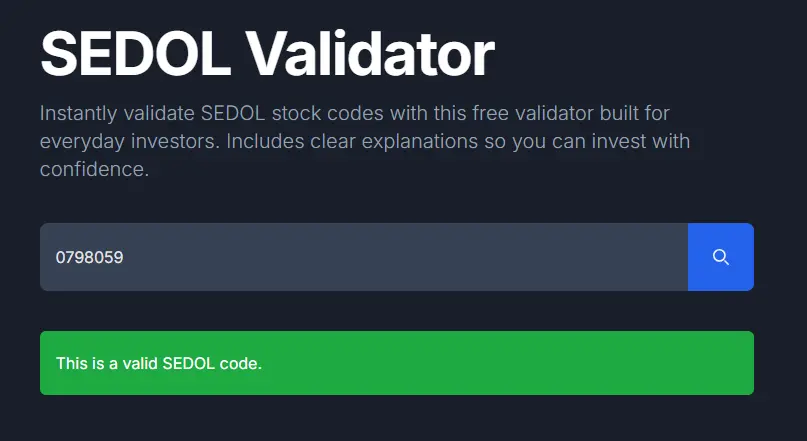
Our SEDOL validator checks the format and validates the check digit instantly.
SEDOL format and structure
SEDOL codes consist of six identifier characters plus one check digit, totaling seven characters.
The format changed significantly on January 26, 2004:
Pre-2004 format:
- All numeric (7 digits only)
- Limited capacity of roughly 10 million codes
- Regional patterns existed (UK/Ireland codes typically started with 0 or 3)
Post-2004 format:
- Alphanumeric (letters and numbers)
- First code issued: B000009
- Vowels excluded (A, E, I, O, U never appear)
- Numbers precede letters at each character position
- All new codes start with a letter
The capacity expansion solved a critical problem. By 2004, the growth in listed securities had nearly exhausted the numeric-only system.
Important: Pre-2004 numeric codes remain fully valid and actively used today. Securities issued before January 26, 2004 keep their original numeric SEDOLs permanently. You'll see both formats in use: legacy numeric codes (like BP's 0798059) and newer alphanumeric codes (starting with B000009) coexist in the same system.
Understanding the SEDOL check digit
The seventh character serves as a check digit that validates the entire code.
SEDOL uses a weighted sum algorithm to calculate this digit:
Weight pattern:
1, 3, 1, 7, 3, 9, 1 (applied to characters 1-7)
Letter values:
Each letter equals 9 plus its alphabet position. So B = 11, C = 12, Z = 35.
Validation rule:
The total weighted sum must be divisible by 10.
This mathematical check catches data entry errors and transmission mistakes automatically. When you enter a SEDOL code, systems can instantly verify its validity before processing any transaction.
Why exclude vowels? It prevents accidentally forming recognizable words that humans might misread or misremember. Pure alphanumeric codes reduce confusion.
Example SEDOL breakdown:
- Code: 0798059
- 079805 = identifier (6 characters)
- 9 = check digit
When you need SEDOL lookup
SEDOL codes work automatically through your broker, but understanding when they're used helps you appreciate their importance.
SEDOL works behind the scenes in these situations:
- Trade execution: Brokers use SEDOL to specify exactly which security to buy or sell. Ticker symbols can be ambiguous, SEDOL codes cannot.
- Settlement systems: After you trade, settlement systems track the transaction using SEDOL to ensure the correct security transfers.
- Portfolio reporting: Fund managers and institutions report holdings using SEDOL codes for precision.
- Share class verification: Companies often have multiple share classes (Class A, Class B). Each gets a unique SEDOL, preventing mix-ups.
The critical distinction:
Consider a company like HSBC that trades in London, New York, and Hong Kong. It has one ISIN (global identifier) but three different SEDOLs (one per exchange).
SEDOL ensures you buy the exact security on the exact exchange you intended, not a similar listing elsewhere.
SEDOL vs ISIN
Understanding the relationship between SEDOL and ISIN reveals how global securities identification actually works.
For UK and Irish securities, SEDOL is embedded inside the ISIN.
The ISIN format follows this structure: Country Code + Padding + SEDOL + ISIN Check Digit
Example breakdown:
- SEDOL: 0798059
- ISIN: GB0007980591
- GB = United Kingdom
- 00 = Padding (always 00 for UK securities)
- 0798059 = SEDOL code
- 1 = ISIN check digit
| Feature | SEDOL | ISIN |
|---|---|---|
| Length | 7 characters | 12 characters |
| Scope | UK/Ireland | Global |
| Format | Alphanumeric | Country code + identifier + digit |
| Issuer | London Stock Exchange | National numbering agencies |
| Check digit | Position 7 | Position 12 |
| Uniqueness | Per exchange listing | Per security (global) |
When to use which:
- SEDOL identifies the specific exchange listing
- ISIN provides global standardization across all markets
Converting ISIN to SEDOL:
For UK securities (ISINs starting with GB), characters 5-11 contain the SEDOL.
Example:
ISIN: GB0007980591
- Position 1-2: GB (country code)
- Position 3-4: 00 (padding)
- Position 5-11: 0798059 (SEDOL)
- Position 12: 1 (ISIN check digit)
This pattern only works for UK and Irish securities. Other countries embed different national identifiers within their ISINs.
SEDOL vs CUSIP
SEDOL and CUSIP serve identical purposes but operate in different geographic regions.
| Feature | SEDOL | CUSIP |
|---|---|---|
| Region | UK/Ireland | US/Canada |
| Length | 7 characters | 9 characters |
| Issuer | London Stock Exchange | CUSIP Global Services |
| Format | 6 chars + check digit | 6 (issuer) + 2 (issue) + check digit |
| Started | 1979 | 1968 |
You cannot convert between SEDOL and CUSIP. They're independent identification systems for different markets.
When you encounter each:
- Trading on London Stock Exchange → SEDOL appears
- Trading on NYSE or NASDAQ → CUSIP appears
- International trading → ISIN wraps whichever national code applies
Think of them as regional license plates. A UK vehicle has a UK plate, a US vehicle has a US plate. The same security can have both if it trades in both regions.
Real-world example
Let's examine how SEDOL works with an actual UK company.
BP plc (British Petroleum)
- Ticker: BP.L (London Stock Exchange)
- SEDOL: 0798059
- ISIN: GB0007980591
Breaking down the codes:
The SEDOL 0798059 uniquely identifies BP's ordinary shares on the London Stock Exchange. This is a pre-2004 SEDOL (all numeric), issued before the 2004 format change to alphanumeric codes.
The 9 serves as the check digit that validates the entire code through the weighted sum algorithm.
The ISIN GB0007980591 embeds the SEDOL within the global format:
- GB (United Kingdom) + 00 (padding) + 0798059 (SEDOL) + 1 (ISIN check digit)
This structure allows both exchange-specific precision (SEDOL) and global standardization (ISIN) to work together seamlessly.
The bottom line
SEDOL codes solve a deceptively complex problem: ensuring absolute precision in securities trading.
Understanding SEDOL reveals how financial infrastructure prevents errors that could cost thousands. While your broker handles SEDOL codes automatically during transactions, knowing how they work helps you verify trades and understand the system protecting your investments. Combine SEDOL with the other key securities identifier codes used across global markets.
SEDOL ensures precision in a market where buying the wrong share class or exchange listing could mean thousands in unexpected losses.
Frequently Asked Questions
How do I validate a SEDOL code?
Use our SEDOL validator tool to instantly check if a SEDOL code is valid. The validator verifies both the format (seven alphanumeric characters with no vowels) and the check digit calculation. Manual validation requires applying weights of 1, 3, 1, 7, 3, 9, 1 to each character, with the total sum divisible by 10.
Why do some companies have multiple SEDOL codes?
Each exchange listing receives its own SEDOL code. When a company trades on multiple exchanges (like HSBC in London, New York, and Hong Kong), each listing gets a unique SEDOL. This ensures precision when specifying which exact market and share class you're trading. The company keeps one global ISIN but maintains separate SEDOLs per exchange.
Where can I find SEDOL codes?
SEDOL codes appear on broker statements, exchange listings, financial databases, regulatory filings and our stock pages which display the SEDOL for each security. The codes are essential for institutional trading and settlement systems.
Can SEDOL codes expire or change?
SEDOL codes remain permanent for the life of the security. Pre-2004 numeric codes (like BP's 0798059) remain valid indefinitely alongside newer alphanumeric codes. A SEDOL only becomes inactive if the security itself is delisted or cancelled. Companies cannot request SEDOL changes, ensuring consistent identification throughout a security's trading life.
When was SEDOL created?
SEDOL launched in 1979 as a standardized identification system for the London Stock Exchange. The format remained numeric-only until January 26, 2004, when alphanumeric codes were introduced starting with B000009. This expansion addressed capacity limits as the number of listed securities grew globally.