
Updated
• 6 min read (EN)
How Many Stocks Should You Own in a Portfolio
There is no single correct number. Academic research points to 20-30 stocks for meaningful diversification. Warren Buffett argues that 3-6 great businesses is all you need if you understand them deeply. The right answer depends on how much time you spend researching and how well you know what you own.
Want to see how Buffett concentrates his portfolio? The Warren Buffett heatmap shows every position and its weight at a glance.
Why the Number Matters
Owning too few stocks means one bad pick can wreck your portfolio. Owning too many means your best picks barely move the needle.
Consider two portfolios. Portfolio A holds 5 stocks at 20% each. When one stock doubles, the portfolio gains 20%. Portfolio B holds 40 stocks at 2.5% each. The same double adds only 2.5%. Portfolio A feels the win. Portfolio B barely notices.
The flip side: when one stock in Portfolio A drops 50%, the portfolio loses 10%. In Portfolio B, the same crash costs just 1.25%. Concentration amplifies both gains and losses.
This tradeoff is at the heart of every portfolio decision. More stocks reduce damage from any single mistake. Fewer stocks increase the reward from each good decision. The goal is finding the number where you reduce enough risk without drowning your returns.
What the Research Says
Academics and legendary investors disagree on the exact number, but they agree on why it matters.
The landmark 1968 study by Evans and Archer found that 10 random stocks captured most diversification benefits. Modern research pushes that number higher. The CFA Institute found that 15 stocks provide peak diversification for large caps, while small-cap portfolios need closer to 26. Beyond 30 stocks, each additional position barely reduces risk.
Buffett takes the opposite view: "Diversification is protection against ignorance. It makes little sense if you know what you are doing." His Berkshire Hathaway portfolio concentrates 65% of its value in just 6 stocks. Charlie Munger went further, holding only 3 stocks personally: Berkshire, Costco, and Daily Journal.
Peter Lynch, who ran the most successful mutual fund in history, advised individual investors to own 3-10 stocks. His Magellan fund held 1,400 at its peak, but he had a team of analysts and decades of experience.
| Dimension | Passive Investor | Active Beginner | Experienced Stock Picker |
|---|---|---|---|
| Number of stocks | 1-3 ETFs (hundreds inside) | 10-15 individual stocks | 8-15 high-conviction picks |
| Research depth | Fund-level only | Reads earnings, checks ratios | Deep financial statement review |
| Risk if wrong | Low (broad diversification) | Moderate (some concentration) | Higher (must pick well) |
| Return potential | Market average | Slightly above or below market | Above market if skilled |
The table shows that experience changes strategy, not stock count. More skill means deeper research per position, not more positions. If you cannot commit the hours, ETFs are the honest answer.
The Diworsification Trap
Peter Lynch coined the term "diworsification" to describe what happens when you own so many stocks that your portfolio becomes an expensive index fund.
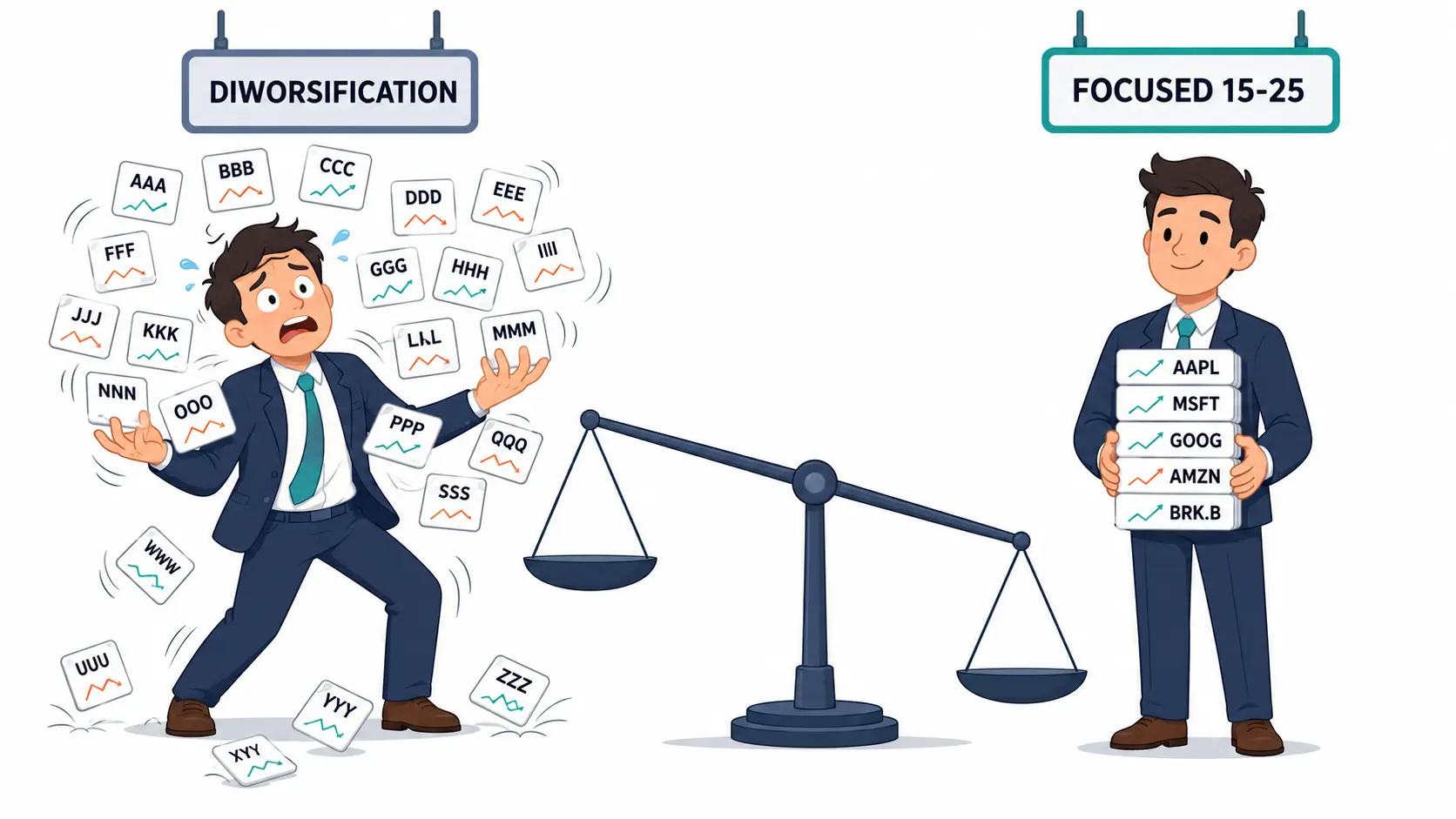
With 40 equal positions, each stock is 2.5% of your portfolio. Your highest conviction pick has the same weight as a stock you barely researched. One stock tripling adds 2.5% to your total return. You did the work of finding a winner but captured almost none of the reward.
More holdings mean more costs. Each position adds trading fees, tax complexity, and monitoring time. Above 30 stocks, you spend more time tracking positions than analyzing whether they deserve to be there.
The warning signs: you own 3 banks but cannot explain why each one is different. You hold 5 tech stocks that all move together. You added a stock months ago and forgot why. When positions overlap or go unmonitored, diversification becomes dilution.
Quality matters more than quantity. Ten stocks you understand deeply will likely outperform 40 you barely follow. Check whether your holdings spread across different sectors rather than just counting positions. A portfolio of 25 tech stocks is not diversified no matter how many names it has.
Finding Your Number
Start with how many stocks you can genuinely research. Every position needs at least a quarterly check: earnings, cash flow trends, and whether the original investment thesis still holds. If you cannot do that for every stock you own, you own too many.
Most individual investors land between 8 and 15 stocks. Below 8, a single bad pick has outsized impact. Above 15, research quality drops and positions go unmonitored. If you do not want to research individual stocks at all, broad ETFs give you instant diversification without the work.
Spread across at least 4-5 sectors. A portfolio of 15 stocks all in technology carries sector risk that no amount of stock picking can fix. Use the Warren Buffett heatmap to see how a concentrated portfolio looks in practice and compare it to your own sector spread.
Start with 8-10 well-researched positions. Add new stocks only when you find something better than your weakest holding, not to reach a target count. Buffett's rule applies at every level: it is better to own a few stocks you understand than many you do not.
Frequently Asked Questions
Is 5 stocks enough for a portfolio? It can work if you accept the risk. With 5 stocks, each position is 20% of your portfolio. One bad pick costs you significantly. This concentration requires deep research and high conviction in every holding. Most investors are better off with 10-15 for balance between concentration and protection.
Can you be too diversified? Yes. Beyond 30 stocks, adding more positions barely reduces risk but steadily dilutes returns. Your best ideas carry less weight, costs increase, and monitoring becomes harder. Peter Lynch called this "diworsification." If your portfolio starts performing like an index fund, consider whether you are paying active management costs for passive results.
Should beginners start with ETFs or individual stocks? ETFs are the safer starting point. A single S&P 500 ETF holds 500 stocks across all sectors with no stock-picking required. As you learn to evaluate earnings and compare valuations, you can gradually add individual stocks alongside your ETF core.
What did Warren Buffett mean by "diversification is protection against ignorance"? Buffett meant that owning many stocks compensates for not knowing enough about each one. If you deeply understand a business, its finances, and its prospects, you do not need 30 others to protect you. But most investors overestimate their knowledge. For non-professionals, Buffett recommends low-cost index funds.