
Updated
• 7 min read (EN)
What Is an ISIN? Format, Check Digit, and Country Codes
An ISIN is the 12-character global stock identifier that every exchange, broker, and clearinghouse uses to specify the exact security being traded. The format is country code (2 chars) + national security number (9 chars) + Luhn check digit (1 char). Apple's ISIN is US0378331005. Verify any ISIN with our ISIN validator.
Why ISIN Matters
The same security can trade on multiple exchanges with different ticker symbols, but it has only one ISIN. That uniqueness is what makes international investing possible: when you buy Nestlé from a US account, the broker, the custodian in Switzerland, the clearinghouse, and the regulator all reference the same ISIN. No translation, no ambiguity.
Ticker symbols don't survive that journey. Nestlé trades in Switzerland, Frankfurt, Munich, Paris, and London with five different ticker symbols and one ISIN (CH0038863350). Tickers also get recycled when companies delist, so historical data tied to a ticker is unreliable. The ISIN stays with the security for life.
ISIN is governed by ISO 6166 and issued by national numbering agencies, with one agency per country, coordinated through the Association of National Numbering Agencies (ANNA). The system is distributed by design: each country's existing national identifier gets wrapped inside the global ISIN format rather than replaced. ISIN doesn't reinvent. It standardises.
How ISIN Works
The 12-character format breaks into three pieces.
Country code is 2 characters from the ISO 3166-1 alpha-2 standard (US, GB, DE, JP, CH). The National Security Identifying Number (NSIN) is 9 characters that encode the country's existing identifier, sometimes with leading zeros for padding when the native code is shorter. The check digit is one digit calculated using the Luhn algorithm, the same checksum credit cards use.
Worked example. Apple's CUSIP is 037833100. The ISIN wraps it into US0378331005:
| Position | Value | Meaning |
|---|---|---|
| 1-2 | US | Country code (United States) |
| 3-11 | 037833100 | CUSIP (US national identifier) |
| 12 | 5 | Luhn check digit |
When the native code is shorter than 9 characters, leading zeros pad the NSIN slot. BP's UK SEDOL is 7 characters (0798059), so the ISIN is GB + 00 + 0798059 + 1 = GB0007980591. The country table in the next section shows the embedded code and padding for every common prefix.
Luhn check digit. The walkthrough for US0378331005:
- Expand letters into digits (A=10, B=11, ..., Z=35). U=30 and S=28 give the 14-digit string 30280378331005.
- From the right, multiply alternating digits by 1 and 2 (rightmost ×1, next ×2, then ×1, alternating). Where doubling exceeds 9, collapse the two digits to one. The 14 products: 5, 0, 0, 2, 3, 6, 8, 5, 3, 0, 8, 4, 0, 6.
- Sum the products: 5+0+0+2+3+6+8+5+3+0+8+4+0+6 = 50. Divisible by 10, so the check digit (5) verifies.
A single-digit typo or a transposition of two adjacent digits both break the divisibility. Format validators reject the ISIN at order entry, before the trade is sent.
ISIN by Country
The country code prefix tells you which national numbering agency issued the ISIN and which native identifier sits inside.
| Country | Code | NSIN system | Example ISIN | Security |
|---|---|---|---|---|
| US | US | CUSIP (9 chars) | US0378331005 | Apple Inc. |
| UK | GB | SEDOL (7 chars + 00 padding) | GB0007980591 | BP plc |
| Germany | DE | WKN (6 chars + padding) | DE0007164600 | SAP SE |
| Japan | JP | Local Securities Identification Code | JP3756600007 | Nintendo |
| Switzerland | CH | Valor (variable + zero padding) | CH0038863350 | Nestlé S.A. |
Same global structure, different embedded system in each country. The country code is also a routing hint: CUSIP Global Services issues every US ISIN, the London Stock Exchange every UK one, WM Datenservice every German one (which assigns the embedded WKN), the Securities Identification Code Committee every Japanese one (with the Tokyo Stock Exchange as its secretariat), SIX Telekurs every Swiss one.
Multinationals stay in their home country's prefix. Nestlé's primary listing is the SIX Swiss Exchange, so its ISIN starts with CH even though the stock trades on five exchanges across three continents. The same logic puts Toyota at JP, AstraZeneca at GB, and SAP at DE.
Where ISIN Misleads
ISIN solves identification across markets. It does not solve everything.
ISIN doesn't pick the exchange: Nestlé's CH0038863350 trades on five exchanges with different prices, different liquidity, and different settlement times. The ISIN identifies the security; you still need a Market Identifier Code (MIC) or exchange ticker to specify which listing to trade. Brokers default to the primary listing unless you specify.
Depositary receipts get separate ISINs: when you trade an American Depositary Receipt (ADR) for a foreign company, you're buying a US-issued instrument that represents the underlying share, not the underlying share itself. Toyota's ordinary shares (JP3633400001) and its NYSE-listed ADR (US8923313071) are different ISINs because they're different legal instruments. Mixing them up is the classic cross-border error.
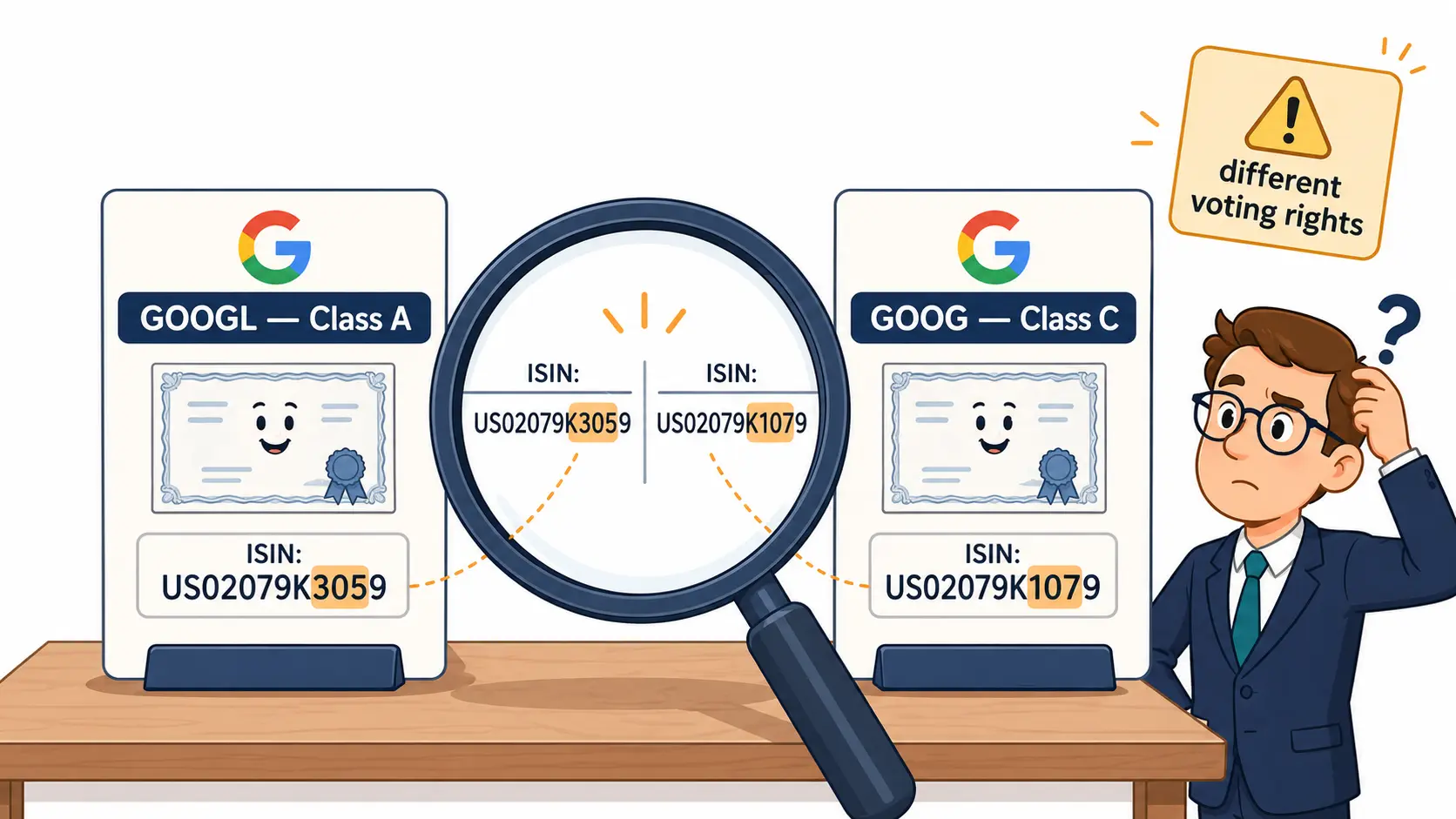
Share classes look similar but are different ISINs: Alphabet has Class A (GOOGL, US02079K3059) and Class C (GOOG, US02079K1079). Same business, different voting rights, different ISINs. The ticker symbols differ by one letter; the ISINs differ by 4 characters near the end. Easy to misread, expensive to misorder.
The "permanent ISIN" rule has a footnote: ISINs are permanent for the life of the security, not the underlying business. Mergers, spin-offs, and corporate restructurings create new legal entities, which require new ISINs. When AT&T spun off Warner Media in 2022, shareholders received a new instrument with a new ISIN.
Old ISINs aren't retired immediately: when a security delists or terminates, its ISIN is reserved for years before reassignment. Historical databases that recycled ISINs incorrectly have caused real settlement errors. Verify any ISIN with our ISIN validator before relying on a vintage record.
ISIN gets you the security. Pairing it with the right exchange, share class, and corporate-action history gets you the trade. Combine ISIN with the other securities identifier codes used across global markets.
Frequently Asked Questions
How do I find a stock's ISIN code? ISIN codes appear on broker confirmations, exchange listings, financial databases, and regulatory filings. Most financial websites display the ISIN alongside ticker symbols and other identifiers. Our stock pages show the ISIN for each security. You can also use our ISIN validator tool to verify and look up ISIN codes.
Why do some stocks have multiple ISIN codes? A single company can have multiple ISIN codes for different securities. Common reasons include different share classes (voting vs non-voting), preferred stock vs common stock, securities listed on different exchanges with different legal structures (ordinary shares vs depositary receipts), or securities denominated in different currencies. Each distinct security instrument receives its own ISIN. However, the same ordinary share trading on multiple exchanges keeps the same ISIN.
Who assigns ISIN codes? National numbering agencies (NNAs) assign ISIN codes for securities issued in their jurisdiction. In the United States, CUSIP Global Services assigns ISINs. In the United Kingdom, the London Stock Exchange assigns them. Each country designates an official NNA responsible for ISIN issuance, coordinated under the Association of National Numbering Agencies (ANNA). This distributed system ensures consistent global standards while respecting national securities regulations.
Do ISIN codes expire or change? ISIN codes remain permanent for the life of the security. Once assigned, an ISIN stays with that security until it's delisted, matures, or is otherwise terminated. Corporate actions like stock splits, dividends, or name changes do not change the ISIN. However, a merger or restructuring that creates a new legal entity will generate a new ISIN. This permanence makes ISIN reliable for historical tracking and regulatory reporting across decades.