
Gepubliceerd
• 7 min. leestijd (EN)
What Are Defensive Stocks? Sectors, Examples, and Returns
Defensive stocks are shares of companies that sell essential goods and services people keep buying regardless of the economy. Coca-Cola, Procter & Gamble, and Johnson & Johnson all fit the profile, with low beta, steady earnings, and long dividend records.
The label describes the business, not a price guarantee. See how individual defensive names like KO, PG, and JNJ have held up against the broader market on the S&P 500 percent change heatmap, which colors every company green or red across multiple timeframes.
Why Defensive Stocks Matter
When earnings collapse across the index, a small group of companies still ships the same boxes of toothpaste, fills the same prescriptions, and bills the same electricity meters. Their revenue keeps moving because their customers cannot stop buying. Investors call those companies defensive, and their shares behave differently from the rest of the market.
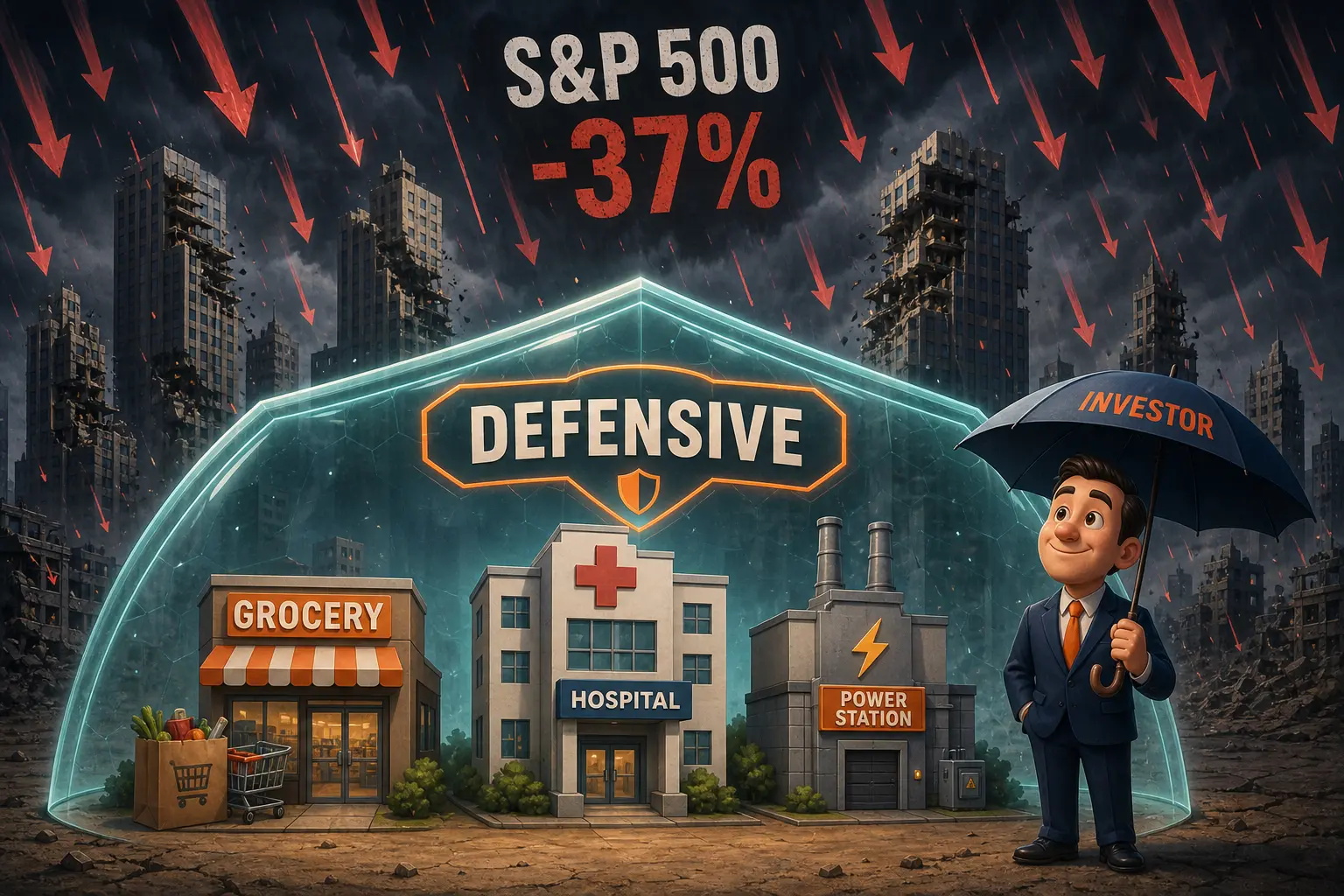
The practical use is portfolio shape. A 60/40 stock-bond split is one way to limit drawdowns; tilting the equity sleeve toward defensive names is another. Both approaches answer the same question: how much loss will the portfolio swallow before the investor stops following the plan?
A concrete example shows the size of the effect. In 2008 only two of the 30 Dow Jones Industrial Average components finished the year positive: Walmart and McDonald's. Walmart climbed roughly 18% while the S&P 500 fell about 37%. The trade-down to value retail and quick-service food was strong enough to push earnings up while the rest of the index shrank.
How Defensive Stocks Work
Three sectors carry most of the defensive label, all sharing one trait: revenue tied to needs rather than wants.
| Sector | What it sells | Why it holds |
|---|---|---|
| Consumer staples | Food, beverages, hygiene, tobacco | Daily-use products with stable volume |
| Utilities | Electricity, gas, water | Regulated rates and inelastic demand |
| Healthcare | Pharma, devices, hospital services | Care needs ignore the business cycle |
The financial signature is just as consistent. Defensive stocks usually carry beta in the 0.20 to 0.80 range, a dividend yield above the market average, and operating cash flow that barely flinches across cycles. Beta below 1.00 means the stock has historically swung less than the broader market: a 0.60 beta name typically loses about 6% when the index drops 10%.
A worked example brings the math down to one stock. Procter & Gamble (PG) recently traded with a beta near 0.40 and a forward dividend yield around 2.78%. PG has raised its dividend for 69 consecutive years, including through 2008 and 2020. If the S&P 500 falls 20% in a downturn, a 0.40 beta predicts roughly an 8% drop in PG, and the dividend keeps paying while the share price recovers. The same arithmetic explains why Coca-Cola (60+ years of raises) and Johnson & Johnson sit in the same bucket.
Costco (COST) is a useful counterpoint. Membership renewal rates above 90% lock in revenue independent of the broader retail tape, which is why COST has posted positive same-store sales through every U.S. recession of the past 20 years.
Defensive Stocks Scenarios Compared
The same defensive label fits very different investors. Match the column to your goal before you size the position.
| Dimension | Income Investor | Drawdown-Averse Investor | Tactical Defensive Tilt |
|---|---|---|---|
| Target yield | 3-5% | 1-3% | 2-4% |
| Typical names | Utilities, dividend kings | Staples, large-cap healthcare | Staples leaders, regulated utes |
| Beta range | 0.30-0.70 | 0.40-0.80 | 0.40-0.80 |
| Risk | Yield traps, rate sensitivity | Premium valuations | Underperformance in bull markets |
| Best for | Retirement income | Sleep-at-night portfolios | Reducing drawdown around peaks |
Two takeaways from the table. Yield-led income investors lean further into utilities and dividend kings, accepting more interest-rate risk for higher payouts. A tactical tilt does the opposite: trim defensive exposure when the cycle turns and recovery names start to lead. The same KO or PG share serves both portfolios, but the role and the position size differ.
Where Defensive Stocks Fall Short
The label hides four real risks that investors miss when they treat defensive as a synonym for safe.
Limitation: Bull markets punish a heavy defensive tilt. Staples and utilities lag when the broader market rallies on growth optimism, so a 100% defensive equity sleeve usually trails the index over a full cycle. The opportunity cost is the gap between the defensive return and the index return, and it compounds over years.
Limitation: Crowded trades push valuations up. When fear spikes, money rushes into KO, PG, and JNJ, and the P/E ratio on those stocks rises with it. Buying defensive names at a 25 P/E means accepting a lower expected return than buying the same names at a 17 P/E. The business is still defensive; the price is not.
Limitation: Utilities are bond proxies. When interest rates rise, the present value of a utility's future cash flows falls and bond yields compete with the dividend, so utility stocks often drop alongside long bonds. The sector is defensive against recession, not against rate moves.
Limitation: Dividends can still get cut. A long history of raises lowers the odds but does not remove them. Pfizer cut its dividend in 2009 after the Wyeth acquisition, and General Electric cut twice during its decline. The check is always the payout ratio and the cash flow behind it, not the streak.
The misconception underneath all four: defensive describes the business, not the share price. A great defensive business at the wrong price still loses money. The cyclical mirror image is just as instructive: see cyclical stocks for why peak earnings often signal the worst time to buy. Many defensive holdings overlap with the blue chip list, but the labels measure different things.
To see which defensive names actually held up over the last quarter, last year, and the last three years, scan the S&P 500 percent change heatmap, where every company sits colored green or red across multiple timeframes.
Frequently Asked Questions
Are defensive stocks the same as safe stocks? No. Defensive describes a business model that holds up when the economy slows, not a guarantee against losses. The 2008 crash dragged every sector lower, and defensive names with stretched valuations have lost money in calmer markets too. Defensive lowers the magnitude of swings, it does not remove them.
What beta range counts as defensive? Most defensive names sit between 0.20 and 0.80. A beta below 1.00 means the stock has historically moved less than the broader market. Use it as a screen, not a verdict: beta is calculated from past returns and changes as a company's debt, mix, and customer base shift.
Which sectors hold the most defensive stocks? Consumer staples, utilities, and healthcare. Telecom is sometimes added because phone and internet bills get paid before discretionary spending. Within each sector the picture is mixed: a regulated water utility is defensive, a merchant power generator is not. Always check the individual business model rather than trusting the sector label.
Should defensive stocks make up my whole portfolio? Rarely. Defensive names protect capital but lag in strong bull markets, so a 100% defensive portfolio gives up most of the upside that long-run compounding depends on. Most investors blend defensive holdings with growth and cyclical names sized to their tolerance for drawdowns and their time horizon.