
Published
• 11 min read (EN)
Apple vs BlackBerry: The Survivorship Bias Trap
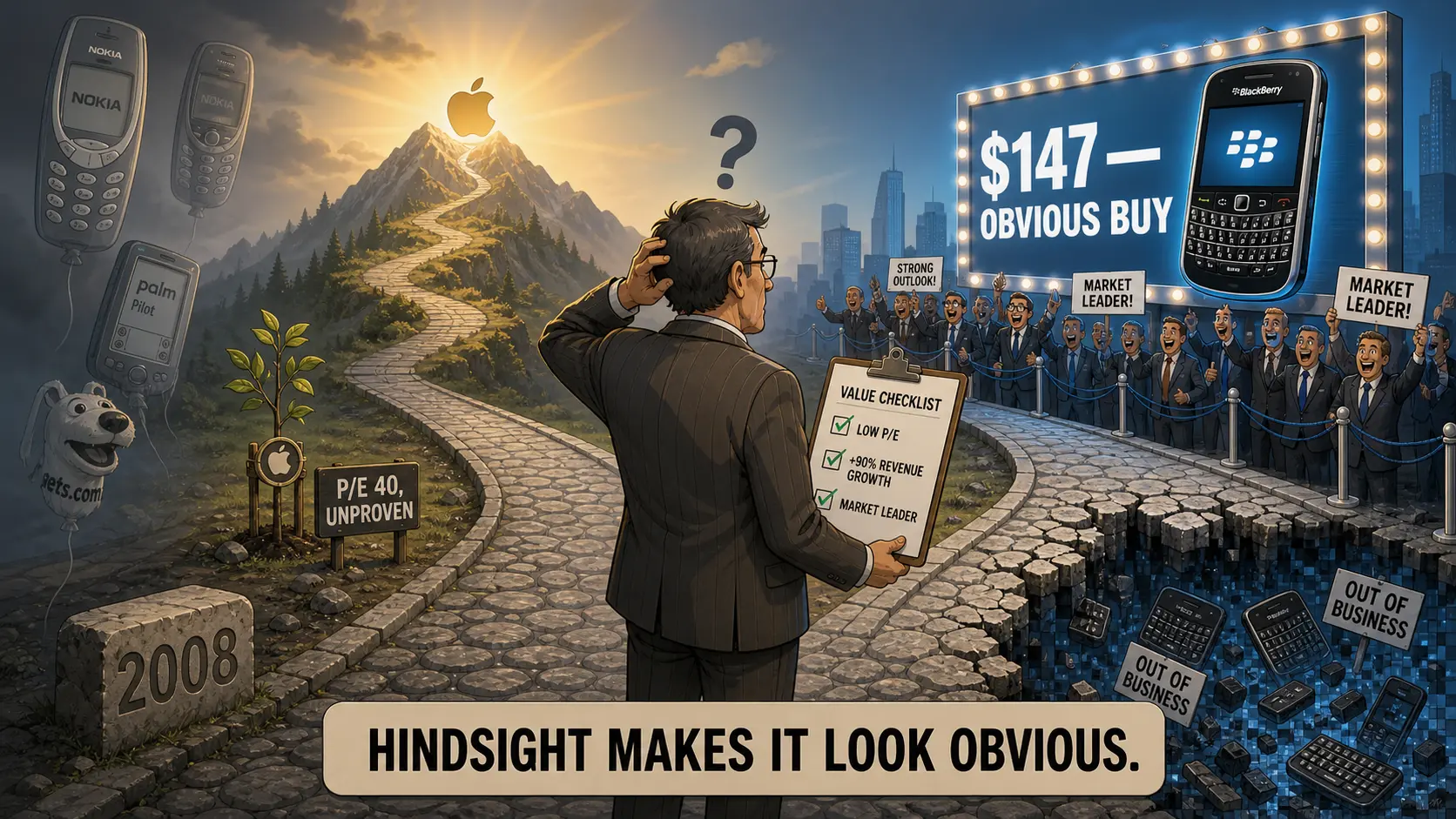
If you'd just bought Apple stock instead of an iPhone in 2007, you'd be very rich. The story is true. The thesis behind it is wrong. At the iPhone launch, BlackBerry was the more attractive stock by every traditional value-investor metric, and the "buy the company whose product you use" logic routed money into Research In Motion (RIMM at the time, today's BB), not AAPL. Hindsight makes Apple look obvious. Survivorship bias is what makes us forget the BlackBerry side of the same trade.
Open Buffett's portfolio heatmap to see the lesson in practice: Buffett bought Apple in 2016, nearly a decade after the iPhone story was clear. He passed on the "obvious" trade because he could not value it.
This is an educational case study on hindsight bias, not investment advice on either stock. The aim is to recover what was actually visible at the iPhone launch and to show what survivorship bias hides when the "if you'd just bought" story gets told.
Apple vs BlackBerry at a Glance (2007–2008)
| Dimension | Apple (AAPL) | BlackBerry (RIMM) |
|---|---|---|
| Position in 2007 | iPhone launched June 2007, 1.39M units sold | Dominant smartphone maker, ~40% US market share |
| Fiscal-year revenue | $24.0B (FY2007) | $6.0B (FY2008, +90% YoY) |
| Fiscal-year net income | $3.5B | $1.3B |
| Smartphone OS share | ~6.5% global (end-2007) | ~20% global, ~40% US (peak) |
| Forward P/E | ~35–45x | ~30x compressing to ~20x by mid-2008 |
| Market cap window | ~$174B (late 2007) | ~$68B (June 2008 peak) |
| Takeaway in 2008 | Premium multiple on an unproven mobile transition | Cheap multiple, dominant position, growing 90% |
The traditional value read on this table puts BlackBerry ahead. Apple traded at a premium for an unproven shift. BlackBerry traded at a discount with 90% revenue growth and the leading smartphone position. The investor who applied the standard playbook in 2008 bought RIMM.
What Apple Looked Like in 2007
Apple in 2007 was a Mac and iPod company that had just launched a $499 handset with no third-party apps, no removable battery, and a single carrier (AT&T) in the US. iPhone units in calendar 2007: 1.39 million. Smartphone OS share at year end: ~6.5%, dwarfed by Symbian's ~65%.
The bull case was a growth narrative about Apple owning the next computing platform. Quantifying that case meant projecting iPhone unit growth, App Store economics that did not yet exist, and operating margins on a hardware product Apple had never built before. Every input was speculative.
The bear case was concrete. Apple traded at a P/E ratio of 35–45x against earnings still mostly Mac and iPod. The phone was expensive, locked to one carrier, and had no business adoption. Calling Apple the obvious 2007 buy means weighting the growth narrative far above the visible fundamentals.
What BlackBerry Looked Like in 2008
Research In Motion hit $147.55 on June 19, 2008, with a market cap near $68 billion, making it Canada's most valuable company. Fiscal 2008 revenue was $6.0 billion, up 90% year over year. The company shipped roughly 14 million devices at an average price of $346, and held about 20% of the global smartphone market and roughly 40% in the US.
The bull case was every metric a value investor weights. Lower multiple than Apple. Faster top-line growth. Dominant in the lucrative enterprise market where switching costs were highest. Net income growing in line with revenue, no dilution, no acquisition risk. The PEG ratio on RIMM was meaningfully below Apple's.
The bear case was speculative: touchscreens were gaining share, Android was about to launch (October 2008), and BlackBerry's keyboard moat depended on enterprise IT departments not changing their minds. Every one of those bears turned out to be right. None was provable in 2008.
When the Survivorship Frame Applies
Survivorship bias is structural to how investing stories are told. The pattern repeats across every era.
| Pattern | What you see | What you miss |
|---|---|---|
| "Just buy the disruptor" | Apple, Amazon, Tesla | Pets.com, Webvan, BlackBerry |
| "Buy the product you use" | Apple (iPhone) | BlackBerry, Nokia, Palm |
| "Hindsight stock pick" | 2007 Apple buy | The dozen RIMM-equivalents of the same era |
| "Track record" fund claims | 9% returns from active funds | 3% once closed and merged funds are included |
| Best for | Storytelling and CTR | Never applying forward to a real position |
The bias bites hardest when the story is told forward but constructed from the surviving sample. You hear "buy the disruptor" alongside Apple's name, but the same advice routes a 2008 investor straight into BlackBerry, Nokia, or Palm. Apply this filter when someone says "if you'd just bought X". Replace "X" with every plausible 2007 buy, weight by what was visible at the time, and the average outcome is closer to BlackBerry than to Apple.
Using Both Stories Together
BlackBerry's stock peaked at $147.55 in June 2008, fell to $66 by February 2011, and trades near $5 today: a 96% drawdown from peak. Apple compounded near 27% per year over the same window. The two outcomes are at opposite extremes of every distribution; the 2008 fundamentals were not.
The lesson is not "do not buy disruptors". The lesson is that hindsight collapses outcome variance to zero. At the time, both stocks had a credible thesis. Apple's required a leap of faith. BlackBerry's required no faith at all. The outcome was the opposite of what the fundamentals signaled.
Forward-looking analysis has to start where the visible fundamentals do, not where the survivors land. Run the value-trap warning signs on every cheap leader: declining ROIC, eroding moat, industry in structural decline. BlackBerry stacked all three by 2010, but only the trailing data shows it cleanly. The forward signal in 2008 was much weaker.
The connection to today is simple: every era has its Apple and its BlackBerry. The "obvious winners" of the current cycle are obvious to everyone reading the same headlines. The companies that look like the next BlackBerry (dominant, profitable, cheap on multiples) are the ones survivorship bias will quietly erase if they fail.
For a working example of disciplined patience, look at Buffett's portfolio. The Apple stake landed in 2016, after the moat was undeniable and the multiple was reasonable. The BlackBerry-equivalent of any era never appeared.
Frequently Asked Questions
Was BlackBerry actually the better stock to buy in 2007? By traditional value-investor metrics, yes. BlackBerry traded at a lower multiple than Apple, was growing revenue 90% year over year, dominated the US enterprise smartphone market with about 40% share, and had visible profits. Apple required a leap of faith on iPhone unit growth, App Store economics that did not yet exist, and operating margins on a product Apple had never built before.
How much would $1,000 in Apple stock from 2007 be worth today? Roughly $130,000, an annualized return near 27.4%. The same $1,000 in the S&P 500 grew to under $8,000 over the same window. The headline makes Apple look like an obvious pick: the headline is what survivorship bias selects for.
What is survivorship bias in investing? Survivorship bias is the habit of analyzing only the winners that survived to the present, ignoring all the comparable bets that failed along the way. Mutual fund studies show 9% returns when only surviving funds are counted versus 3% once closed and merged funds are included. The bias systematically inflates how easy good returns look in retrospect.
How do I avoid the BlackBerry trap when picking stocks today? Treat any "buy the company whose product you use" thesis as an instinct to verify, not a thesis itself. Run the value-trap checks: 5-year ROIC trend, free-cash-flow conversion, moat durability, capital allocation. Then check the multiple. A cheap leader in a stable industry deserves a look. A cheap leader in a market about to be disrupted is the BlackBerry of the next era.