
Updated
• 6 min read (EN)
Growth vs Value Stocks: One Always Loses
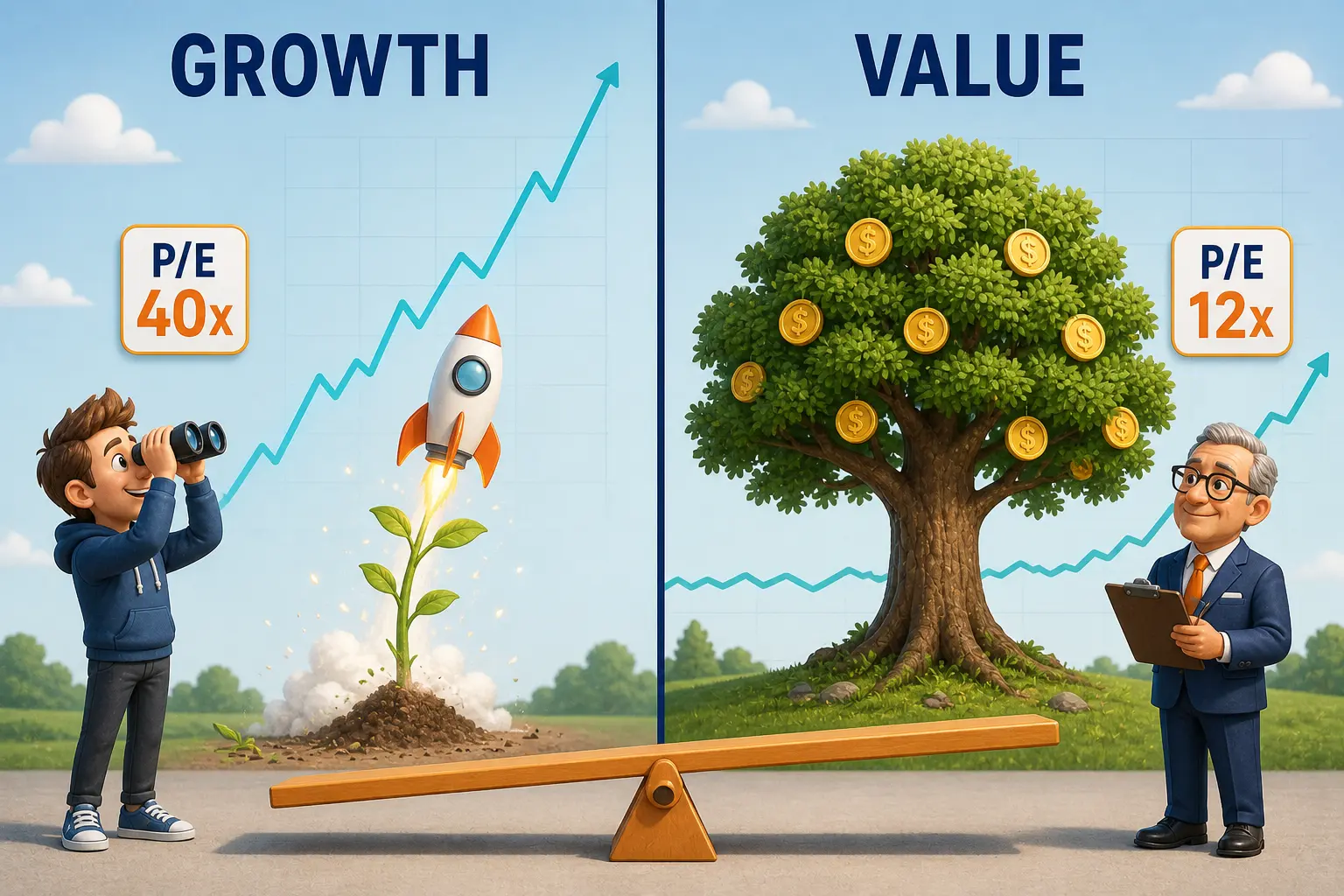
Growth stocks trade at high valuations because earnings are rising fast. Value stocks trade at low valuations because the market underprices their fundamentals. The question is not which is better: it depends on your time horizon, income needs, and how much volatility you accept.
See which S&P 500 stocks trade at growth or value P/E levels on the stock market heatmap.
Growth vs Value Stocks at a Glance
| Dimension | Growth Stocks | Value Stocks |
|---|---|---|
| Valuation | High P/E (often above 30) | Low P/E (often below 18) |
| Earnings trend | Rising fast, reinvested into expansion | Stable, returned to shareholders |
| Dividends | Low or zero | Higher, often 2-5% yield |
| Typical sectors | Tech, consumer discretionary, biotech | Financials, energy, utilities, staples |
| Risk profile | High volatility, big drawdowns possible | Lower volatility, smaller swings |
| Returns driver | Share price appreciation | Dividends plus price recovery |
| Best for | Long horizon, no income needed | Income seekers, conservative investors |
What Growth Stocks Offer
Growth stocks are companies expanding revenue and earnings faster than the market average. Investors pay a premium P/E ratio for that speed, betting future profits justify today's price.
The reward for getting it right is large. From the COVID low in March 2020 through early 2026, the S&P 500 Growth index returned roughly 200%, compared to about 130% for the Value index. Growth stocks dominated the 2010s as well, powered by companies like Apple, Nvidia, and Amazon reinvesting profits into expansion rather than paying dividends.
Limitation: Growth stocks price in expectations. When earnings per share growth slows or misses projections, the correction is severe. In 2022, the S&P 500 Growth index fell 29% while the Value index lost only 5%. High valuations leave no cushion for disappointment.
Concentration risk is real. The top 10 growth stocks make up roughly 56% of the growth index's weight. One earnings miss from a mega-cap drags the entire category.
What Value Stocks Offer
Value stocks trade below what their earnings, assets, or cash flows suggest they are worth. The bet: the market has overlooked or punished them unfairly, and the price will catch up to reality.
Since 1927, value stocks have outperformed growth by an average of 4.4% per year (Dimensional Fund Advisors data). The premium shows up unevenly: value crushed growth by roughly 90% over the 7 years following the dot-com crash in 2000. During other decades, growth dominated.
Value stocks tend to pay meaningful dividends. Companies in financials, energy, and consumer staples earn steady cash and distribute it because they have fewer reinvestment opportunities. For investors who want regular dividend income, value stocks provide what growth stocks do not.
Limitation: "Cheap" does not always mean undervalued. Value traps look like bargains but keep getting cheaper because the business is declining. A bank with a P/E of 7 might face deteriorating loan quality. A retailer at a 50% discount might be losing market share permanently. Low valuation requires a thesis about recovery, not blind trust in the numbers.
When to Favor Growth vs Value
| Scenario | Favors | Why |
|---|---|---|
| Bull market, low interest rates | Growth | Cheap capital fuels expansion, market rewards future profits |
| Rising interest rates | Value | Higher rates discount future earnings, penalizing growth |
| Economic recovery | Value | Cyclical value sectors rebound fastest after recessions |
| Technology innovation cycle | Growth | New platforms create outsized earnings expansion |
| High inflation | Value | Energy and commodity producers benefit directly |
| Approaching retirement | Value | Dividend income and lower volatility protect capital |
Favor growth when: you have a 10+ year horizon, tolerate large drawdowns, and do not need dividends. Growth rewards patience through price appreciation.
Favor value when: you want income, prefer smaller swings, or believe the economy is entering a recovery phase. Value outperformed growth by 6% in the 12 months after earnings growth bottomed in past cycles (Schroders data).
Using Growth and Value Together
The two styles move in cycles. Growth dominated the 2010s. Value led after the dot-com crash and has regained ground in 2025-2026 as interest rates stayed elevated. Holding both captures whichever style the current environment rewards.
A broad market index fund blends both automatically. The S&P 500 holds growth giants like Nvidia alongside value stalwarts like JPMorgan Chase. For investors who want to tilt, adding a value ETF when growth P/E ratios stretch beyond historical norms is one approach.
The P/E vs PEG comparison helps separate expensive growth from fairly priced growth: a stock with a high P/E but PEG below 1.5 may still be reasonably valued for its earnings speed.
Warren Buffett argued in his 1992 shareholder letter that the distinction is artificial: "Growth is always a component in the calculation of value." A cheap stock with no growth is not valuable. A fast grower at a reasonable price is the best of both.
Compare P/E ratios across the S&P 500 on the stock market heatmap to spot which stocks trade at growth or value multiples today.
Frequently Asked Questions
Can a stock be both a growth stock and a value stock? Yes. Stocks migrate between categories over time. A growth company whose earnings plateau may start trading at value multiples. A beaten-down company that reignites growth can shift the other way. The labels describe a snapshot, not a permanent identity.
Are growth stocks riskier than value stocks? In terms of price volatility, yes. Growth stocks fell 29% in 2022 while value stocks fell only 5%. Growth valuations depend on future earnings projections, so any disappointment triggers sharp sell-offs. Value stocks carry different risks: the business may keep deteriorating despite the low price.
Do value stocks always pay dividends? Not always, but most do. Value stocks tend to be mature companies with steady cash flows and fewer reinvestment needs, so they return profits through dividends. Some value stocks use share buybacks instead.
Which has performed better historically: growth or value? Since 1927, value has outperformed growth by about 4.4% per year on average. The premium is not consistent: growth dominated the 2010s while value led the 2000s. Neither style wins permanently, which is why holding both reduces timing risk.