
Actualizado
• 7 min. de lectura (EN)
What Is a CUSIP Number? 9 Digits, US/Canada, How to Find It
CUSIP is a 9-character alphanumeric code that uniquely identifies securities issued in the United States and Canada. It stands for Committee on Uniform Securities Identification Procedures, and CUSIP Global Services has issued the codes since 1968.
Our CUSIP validator checks any code's format and verifies its check digit in one step.
What is a CUSIP number?
CUSIP gives every distinct security in North America a permanent, unambiguous identifier. Ticker symbols differ between platforms and can be reused; the CUSIP follows the security from issuance through settlement.
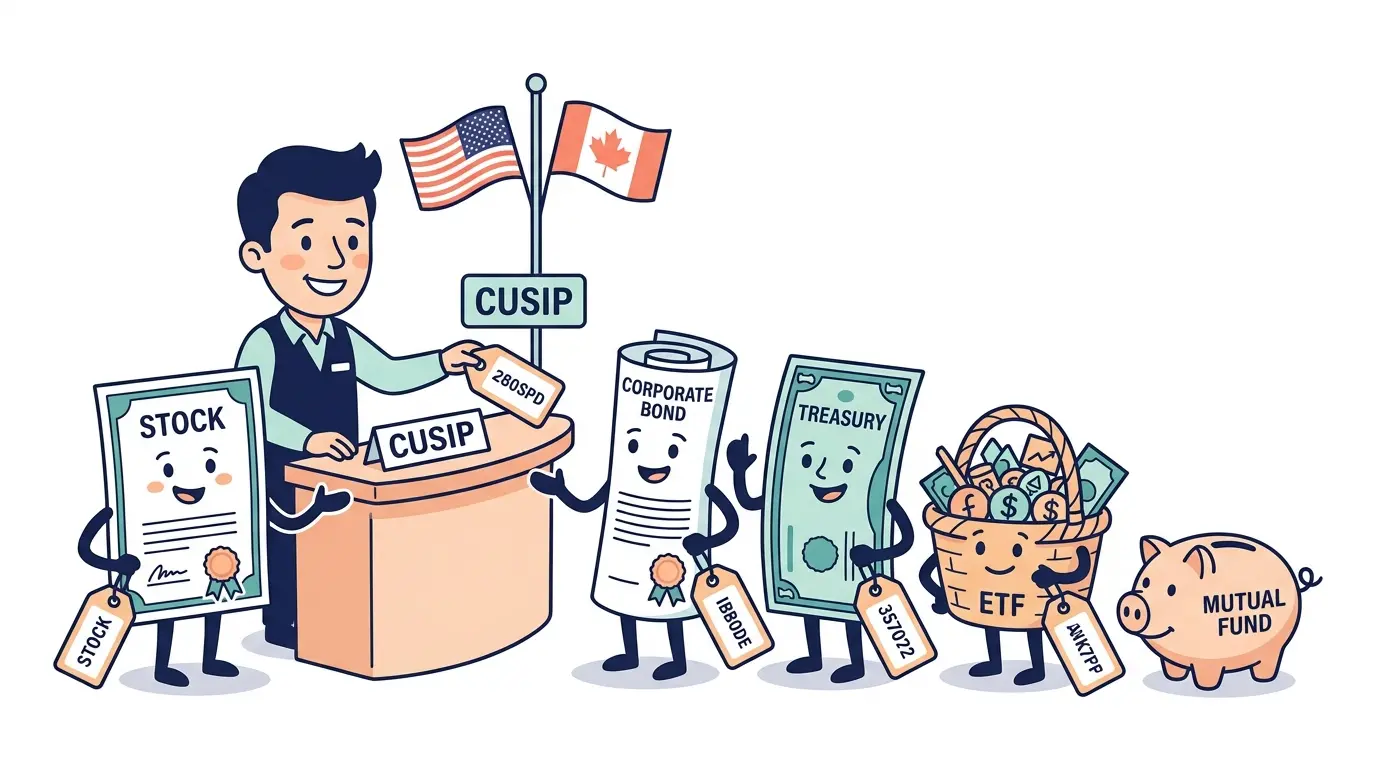
The system covers far more than stocks. Corporate bonds, municipal securities, US Treasuries, commercial paper, ETFs, mutual funds, and derivatives all carry CUSIP identification. That makes CUSIP the backbone of North American fixed income markets, where most bonds have no exchange ticker.
Not a Federal ID. A CUSIP identifies one specific security: a stock, a bond issue, a share class. The Employer Identification Number (EIN, or Federal Tax ID) identifies the company itself for US tax purposes. The two systems are unrelated, even though both run nine characters.
CUSIP format and structure
CUSIP codes are nine characters: six for the issuer, two for the specific issue, and one check digit.
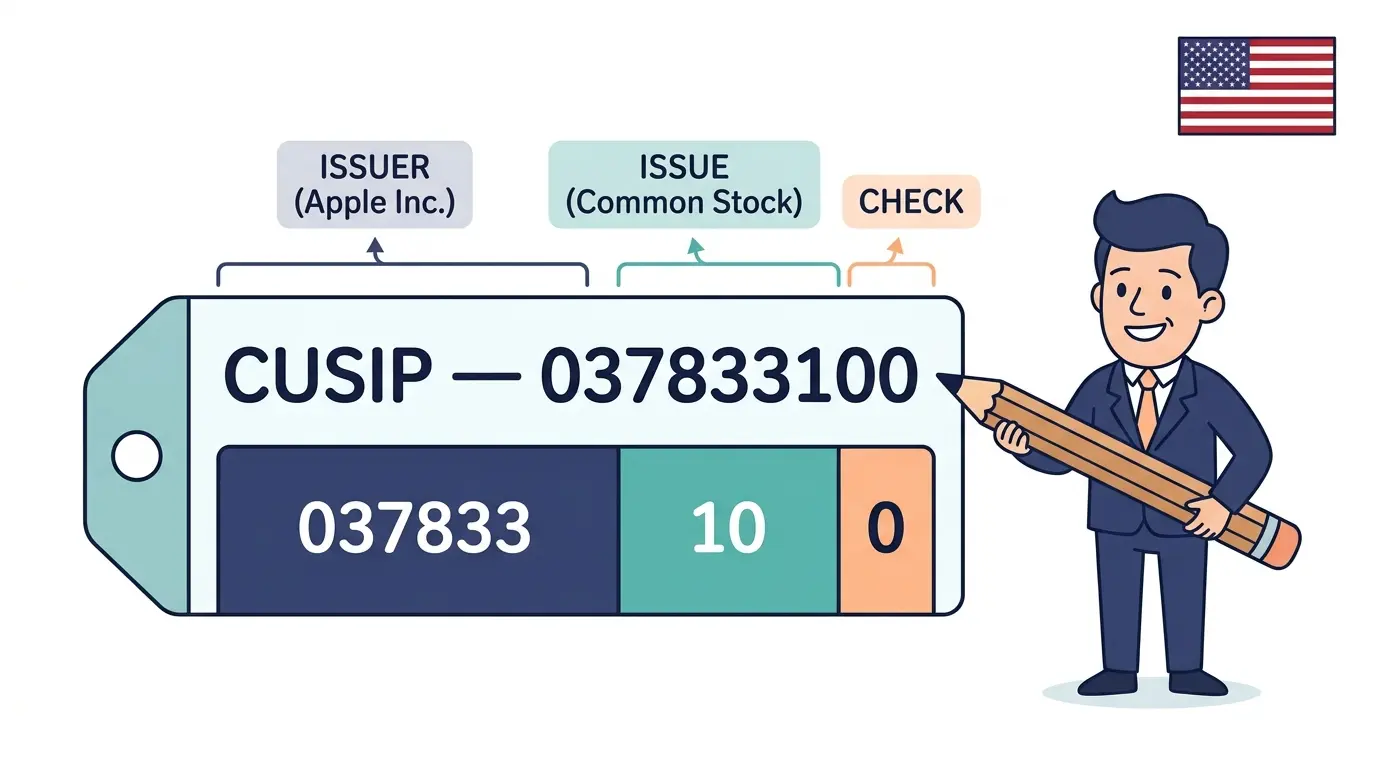
Structure breakdown:
- Characters 1-6: Issuer (company or government entity)
- Characters 7-8: Issue identifier (security type or specific bond issue)
- Character 9: Check digit
The issuer code (first six characters) is permanent. Apple Inc. uses 037833, and every Apple security starts with these six characters. The issue identifier (characters 7-8) distinguishes between common stock, preferred shares, individual bond issues, and so on. The system can therefore tell apart hundreds of distinct securities from a single issuer.
Example breakdown for Apple common stock:
- Code: 037833100
- 037833 = Apple Inc. (issuer)
- 10 = Common stock identifier
- 0 = Check digit
The CUSIP check digit
The ninth character is a check digit that validates the first eight.
CUSIP uses a Modulus 10 algorithm, a variant of the Luhn check used on credit card numbers. The validation runs automatically inside trading systems: data entry typos and most single-character transmission errors fail the check before they reach settlement.
How the algorithm works:
- Convert letters to numeric values: A = 10, B = 11, through Z = 35.
- Starting from the right and excluding the check digit, multiply every other digit by 2.
- Sum all individual digits. A doubled value of 14 becomes 1 + 4 = 5.
- The check digit makes the total divisible by 10.
How to find a CUSIP number
Most retail trades never require a manual lookup. CUSIP appears on broker trade confirmations, account statements, and 1099 tax forms. Most financial websites display the CUSIP next to the ticker on every US-listed security page.
For research outside those flows, several approaches work:
- Pull it from a US ISIN: US and Canadian ISINs embed the CUSIP at positions 3 through 11. ISIN US0378331005 contains CUSIP 037833100.
- Broker or vendor security pages: Fidelity, Schwab, Morningstar, and most institutional vendors display the CUSIP for every US-listed security.
- For municipal bonds: the MSRB's EMMA system is the canonical reference. CUSIPs appear on every official statement, trade record, and continuing disclosure filing.
- For US Treasuries: TreasuryDirect.gov publishes CUSIPs alongside every auction result and outstanding issue.
- For new issuance: CUSIP Global Services, operated by S&P Global, maintains the official central database and the application portal for new CUSIPs.
For non-US and non-Canadian securities, the ISIN does not contain a CUSIP. Those use country-specific identifiers: SEDOL for UK and Ireland, WKN for Germany, and others elsewhere.
CUSIP vs ISIN
CUSIP and ISIN are not competing identifiers: they nest.
For US and Canadian securities, the CUSIP is embedded inside the ISIN. The ISIN structure is: country code (2) + CUSIP (9) + ISIN check digit (1).
Example breakdown for Apple:
- CUSIP: 037833100
- ISIN: US0378331005 = US + 037833100 + 5
| Feature | CUSIP | ISIN |
|---|---|---|
| Length | 9 characters | 12 characters |
| Scope | US and Canada | Global |
| Format | Alphanumeric | Country code + national ID + digit |
| Issuer | CUSIP Global Services | National numbering agencies |
| Check digit | Position 9 | Position 12 |
| Uniqueness | Per security (North America) | Per security (global) |
Use CUSIP within US or Canadian markets; use ISIN when cross-jurisdiction standardisation matters more. Knowing the CUSIP gets the ISIN immediately: prepend US (or CA), append the ISIN check digit, and the conversion is done.
CUSIP vs SEDOL
CUSIP and SEDOL serve the same purpose in different regions. Each assigns a unique national identifier to every security that trades in its market.
| Feature | CUSIP | SEDOL |
|---|---|---|
| Region | US and Canada | UK and Ireland |
| Length | 9 characters | 7 characters |
| Issuer | CUSIP Global Services | London Stock Exchange |
| Format | 6 (issuer) + 2 (issue) + check digit | 6 chars + check digit |
| Started | 1968 | 1979 |
There is no direct conversion between CUSIP and SEDOL. A company that trades in both regions carries both codes, with a single global ISIN tying them together.
CUSIP in practice
Two concrete cases show where CUSIP precision matters.
Share class precision: Alphabet Inc.
Alphabet trades as GOOGL (Class A, voting) and GOOG (Class C, non-voting). The two share classes carry different CUSIPs:
- Class A (GOOGL): 02079K305
- Class C (GOOG): 02079K107
The first six characters (02079K) are identical because the issuer is the same. The issue identifier in positions 7 and 8 (30 vs 10) is what distinguishes the share class. CUSIP makes sure a buy order for voting shares does not accidentally execute against non-voting shares.
Bond maturity precision: US Treasuries
Every US Treasury issuance gets its own CUSIP. A 10-year note auctioned on one date has a different CUSIP than a 10-year note auctioned on another date, because the coupon and maturity differ. The fixed income market relies on this granularity: every coupon, every maturity, every tranche needs its own permanent identifier.
CUSIP is the layer of identification that lets US and Canadian markets settle trades across thousands of asset types without ambiguity. When you need to verify a CUSIP yourself, the CUSIP validator checks the format and the check digit in one step. For the wider picture of how identifier systems route across borders, see the full set of securities identifier codes used across global markets.
Frequently Asked Questions
How do I find a CUSIP number? CUSIP numbers appear on broker trade confirmations, account statements, 1099 tax forms, and most financial websites that list a US-traded security. For US ISINs that start with US, characters 3 through 11 already contain the CUSIP. Bond-specific CUSIPs are published through the MSRB's EMMA system, and CUSIP Global Services maintains the official central database.
Is a CUSIP number the same as a Federal ID (EIN)? No. A CUSIP identifies one specific security, such as a single stock, a bond issue, or a share class. A Federal Employer Identification Number (EIN, sometimes called the Federal Tax ID) identifies a company or other legal entity for US tax purposes. The two systems are issued by different organisations for different reasons and they do not overlap.
Why do some companies have multiple CUSIP numbers? A single company can carry many CUSIPs: one per distinct security it issues. Common reasons include different share classes (Class A versus Class B), preferred stock versus common stock, separate bond issues with different maturities and coupons, convertibles, and warrants. The same common stock keeps a single CUSIP even when it trades on multiple US exchanges.
How do you convert CUSIP to ISIN? For a US security, prepend US to the CUSIP and append the ISIN check digit. Apple's CUSIP 037833100 becomes ISIN US0378331005. Canadian securities follow the same pattern with a CA prefix. The conversion only works for US and Canadian securities. Markets like the UK and Germany embed different national identifiers (SEDOL, WKN) inside their ISINs.