
Actualizado
• 7 min. de lectura (EN)
SEDOL Code Explained: 7 Characters, UK Stocks, ISIN Link
SEDOL is a 7-character alphanumeric code that uniquely identifies securities trading on UK and Irish exchanges. It stands for Stock Exchange Daily Official List, and the London Stock Exchange has issued them since 1979.
Our SEDOL validator checks any code's format and verifies its check digit in one step.
What is a SEDOL code?
SEDOL exists to remove ambiguity from securities trading. Ticker symbols recycle and overlap across exchanges; company names change. The London Stock Exchange issues a SEDOL to every security, share class, and exchange listing under its remit, and that code stays with the security for life.
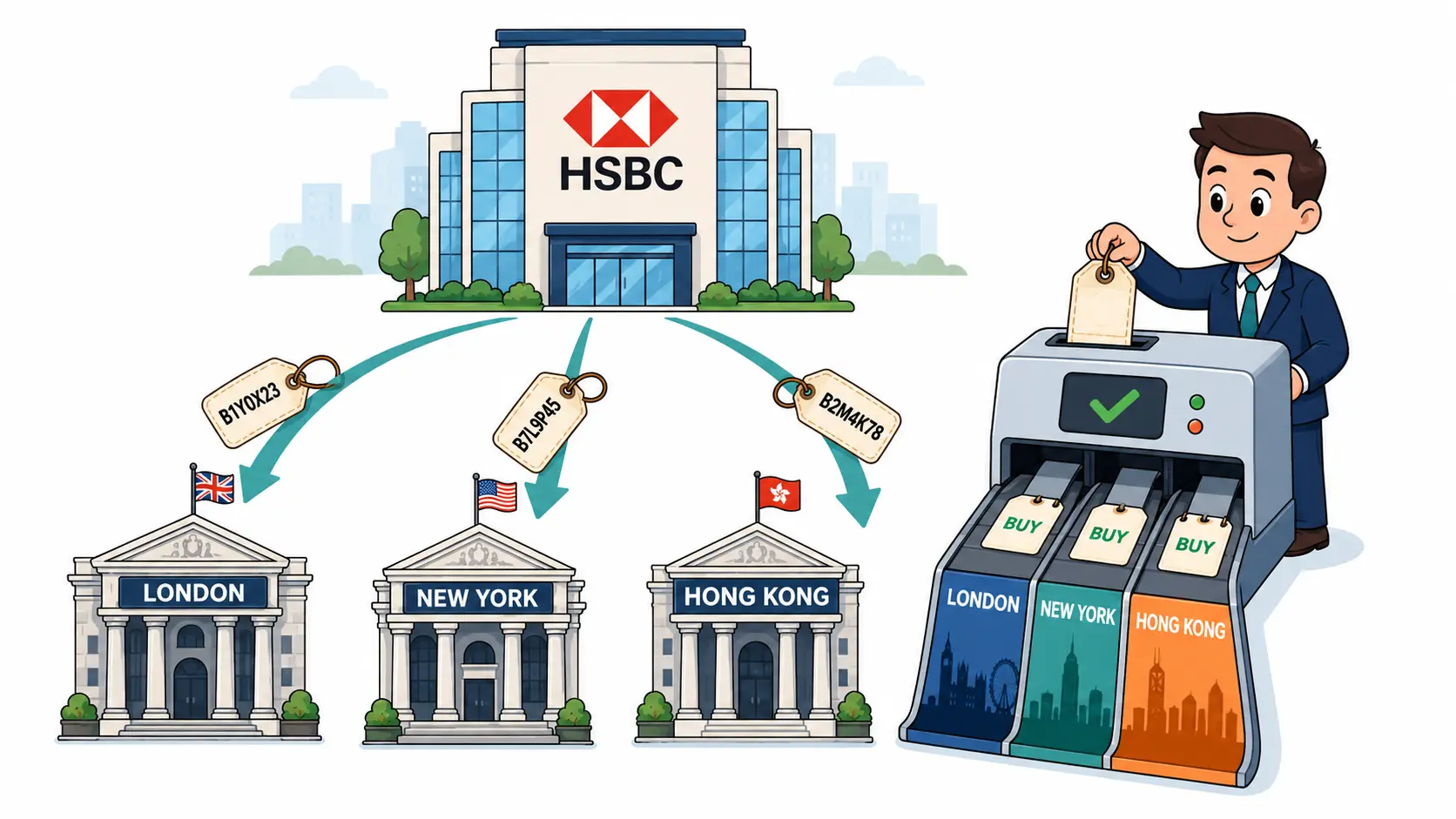
The same company can carry multiple SEDOLs if it trades on more than one exchange. HSBC has separate codes for its London, New York, and Hong Kong listings, even though all three represent shares in the same global business. Brokers, custodians, and settlement systems route on the SEDOL to make sure a buy order for one listing does not accidentally execute against another.
SEDOL format and structure
SEDOL codes are seven characters: six identifier characters and one check digit. The format changed on January 26, 2004.
Pre-2004 format:
- All numeric (7 digits)
- Capacity of roughly 10 million codes
- UK and Ireland codes typically started with 0 or 3
Post-2004 format:
- Alphanumeric
- Vowels excluded (A, E, I, O, U never appear)
- First code issued: B000009
- All new codes start with a letter
The capacity expansion solved a real shortage. By the early 2000s the growth in listed securities had nearly exhausted the numeric-only system, so the LSE introduced letters and reserved the leading-letter pattern for everything new.
Important: Pre-2004 numeric codes stay fully valid. BP's SEDOL of 0798059, issued before the format change, still routes its London-listed ordinary shares today, alongside post-2004 alphanumeric codes in the same system.
The SEDOL check digit
The seventh character is a check digit that validates the first six.
Weight pattern: 1, 3, 1, 7, 3, 9, 1 (applied to characters 1 through 7).
Letter values: each letter equals 9 plus its alphabet position. B = 11, C = 12, Z = 35.
Validation rule: the total weighted sum must be divisible by 10.
The check digit catches single-character typos and most transposition errors before they reach a trading system. The vowel exclusion solves a separate problem: it stops alphanumeric codes from accidentally spelling words a human eye might autocorrect or misread.
Example breakdown for 0798059:
- 079805 = identifier (6 characters)
- 9 = check digit
How to find a SEDOL code
Most retail investors never look one up manually. SEDOL appears on broker trade confirmations, ISA and SIPP statements, and the fund factsheets fund managers publish for every share class. Institutional users go straight to LSEG's SEDOL Masterfile, the canonical reference covering millions of global securities.
For research outside those flows, three quick approaches work:
- Pull it from an existing ISIN: UK and Irish ISINs embed the SEDOL at positions 5 through 11. ISIN GB0007980591 contains SEDOL 0798059.
- Search a vendor security page: Morningstar UK, AJ Bell, Cbonds, and major brokers expose SEDOL alongside ticker and ISIN on every UK-listed security page.
- Check the fund factsheet: Aegon, Schroders, and other UK fund managers publish SEDOL per share class on every product factsheet.
For US, German, and other non-UK securities, the ISIN does not embed a SEDOL. Those securities can still receive a UK-issued SEDOL when they trade on the LSE international order book, but the code lives separately from their home-country identifier (CUSIP for US, WKN for Germany).
SEDOL vs ISIN
SEDOL and ISIN are not competing identifiers: they nest.
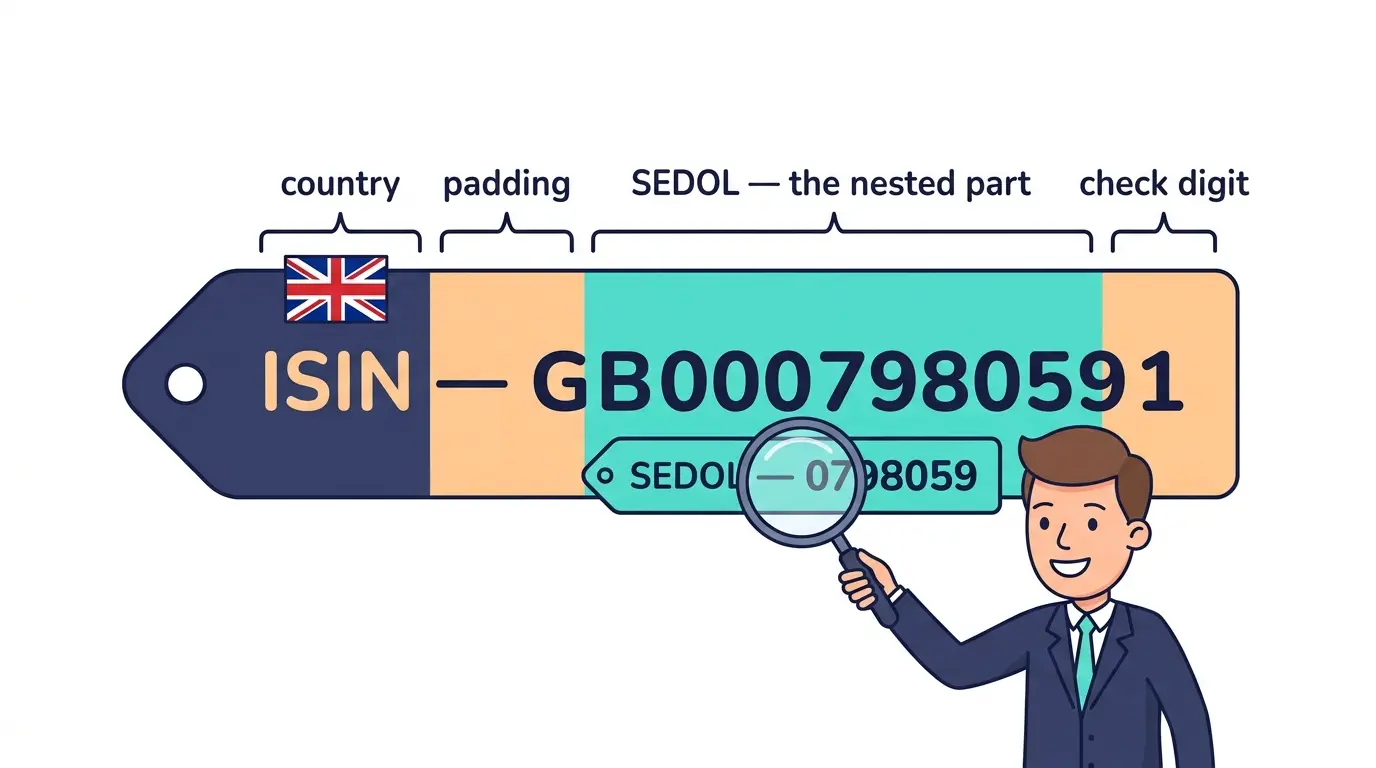
For UK and Irish securities, the SEDOL is embedded inside the ISIN. The ISIN structure is: country code (2) + padding (2) + SEDOL (7) + ISIN check digit (1).
Example breakdown for BP:
- SEDOL: 0798059
- ISIN: GB0007980591 = GB + 00 + 0798059 + 1
| Feature | SEDOL | ISIN |
|---|---|---|
| Length | 7 characters | 12 characters |
| Scope | UK and Ireland | Global |
| Format | Alphanumeric | Country code + identifier + digit |
| Issuer | London Stock Exchange | National numbering agencies |
| Check digit | Position 7 | Position 12 |
| Uniqueness | Per exchange listing | Per security globally |
Use SEDOL when you need to specify the exact exchange listing. Use ISIN when standardisation across markets matters more than the listing detail. For a UK security, knowing one gets you the other: prepend GB00 to the SEDOL, append the ISIN check digit, and the conversion is done. The reverse works for any GB-prefixed ISIN.
SEDOL vs CUSIP
SEDOL and CUSIP serve the same purpose in different regions: each assigns a unique national identifier to every security that trades in its market.
| Feature | SEDOL | CUSIP |
|---|---|---|
| Region | UK and Ireland | US and Canada |
| Length | 7 characters | 9 characters |
| Issuer | London Stock Exchange | CUSIP Global Services |
| Format | 6 chars + check digit | 6 (issuer) + 2 (issue) + check digit |
| Started | 1979 | 1968 |
There is no direct conversion between SEDOL and CUSIP. They are independent systems built for different markets. A security that trades in both regions (a UK-listed company with an ADR in New York, for example) carries both codes, with a single global ISIN tying them together.
SEDOL in practice
BP plc gives a clean worked example.
- Ticker: BP.L (London Stock Exchange)
- SEDOL: 0798059
- ISIN: GB0007980591
The SEDOL identifies BP's ordinary shares on the London Stock Exchange. The trailing 9 is the check digit that confirms the first six characters were transmitted correctly. The ISIN wraps the SEDOL with the country prefix and its own global check digit, giving counterparties anywhere a single canonical reference.
For a UK investor placing an order, the SEDOL is the precision layer. It makes sure a buy for BP ordinary shares does not accidentally execute against BP preferred shares, the New York ADR, or a similarly-named smaller listing.
A SEDOL is the layer of identification that lets UK markets settle trades without ambiguity. Most of the time it runs in the background of every order ticket; when you need to verify one yourself, the SEDOL validator checks format and check digit in one step. For the wider picture of how cross-border trading actually routes, see the full set of securities identifier codes used across global markets.
Frequently Asked Questions
What does SEDOL stand for? SEDOL stands for Stock Exchange Daily Official List. The London Stock Exchange has issued the codes since 1979 to uniquely identify securities trading on UK and Irish exchanges. The format stayed numeric-only until January 26, 2004, when alphanumeric codes were introduced to expand capacity.
How do I find a SEDOL code? SEDOL codes appear on broker trade confirmations, ISA and SIPP statements, and the fund factsheets fund managers publish for every share class. Public references include the LSEG SEDOL Masterfile, Morningstar UK, and broker security pages. For a UK ISIN that starts with GB, characters 5 through 11 already contain the SEDOL.
What is the difference between ISIN and SEDOL? SEDOL is a 7-character UK and Ireland identifier issued by the London Stock Exchange. ISIN is the 12-character global standard issued by national numbering agencies. For UK securities the SEDOL is embedded inside the ISIN at positions 5 through 11, so one UK security has a single global ISIN but a separate SEDOL for each exchange listing.
How do you convert SEDOL to ISIN? For a UK security, prepend GB00 to the SEDOL and append the ISIN check digit. BP's SEDOL 0798059 becomes ISIN GB0007980591. The conversion only works for UK and Irish securities. Markets like the US and Germany embed different national identifiers (CUSIP, WKN) inside their ISINs, so the SEDOL alone cannot generate the ISIN for those.