
Updated
• 6 min read (EN)
What Is DCA: Buy Every Dip Without Trying
DCA (dollar-cost averaging) means investing a fixed amount on a regular schedule, regardless of price. You buy more shares when prices drop and fewer when prices rise. The result: your average cost per share tends to land below the average market price over time.
Model the long-term effect of fixed monthly investments with the dividend calculator: plug in any amount and see how contributions compound over 5, 10, or 20 years.
Why DCA Removes the Timing Problem
Most investors do not have $50,000 sitting in a bank account waiting to be deployed. They earn income monthly and invest from each paycheck. For these investors, DCA is not a strategy to debate: it is the default.
The classic argument against DCA compares it to lump-sum investing. A Vanguard study covering 1976 to 2022 across the US, UK, and Australia found that investing everything at once outperformed DCA about two thirds of the time, with a 2-3% edge over 10 years. Mathematically, putting money to work sooner gives it more time to grow.
But that comparison misses the point for most people. The person investing $500 per month does not have the lump-sum alternative. And even investors who receive a windfall face a real psychological barrier: deploying $100,000 the day before a 20% crash is a searing experience that makes people quit investing entirely.
DCA solves a behavioral problem, not a mathematical one. It keeps investors in the market through downturns because each monthly purchase buys more shares at lower prices. A bear market becomes a discount, not a disaster. That discipline compounds over decades.
How DCA Works
The mechanics are straightforward. Pick a fixed dollar amount, choose a schedule (monthly is most common), and invest regardless of price.
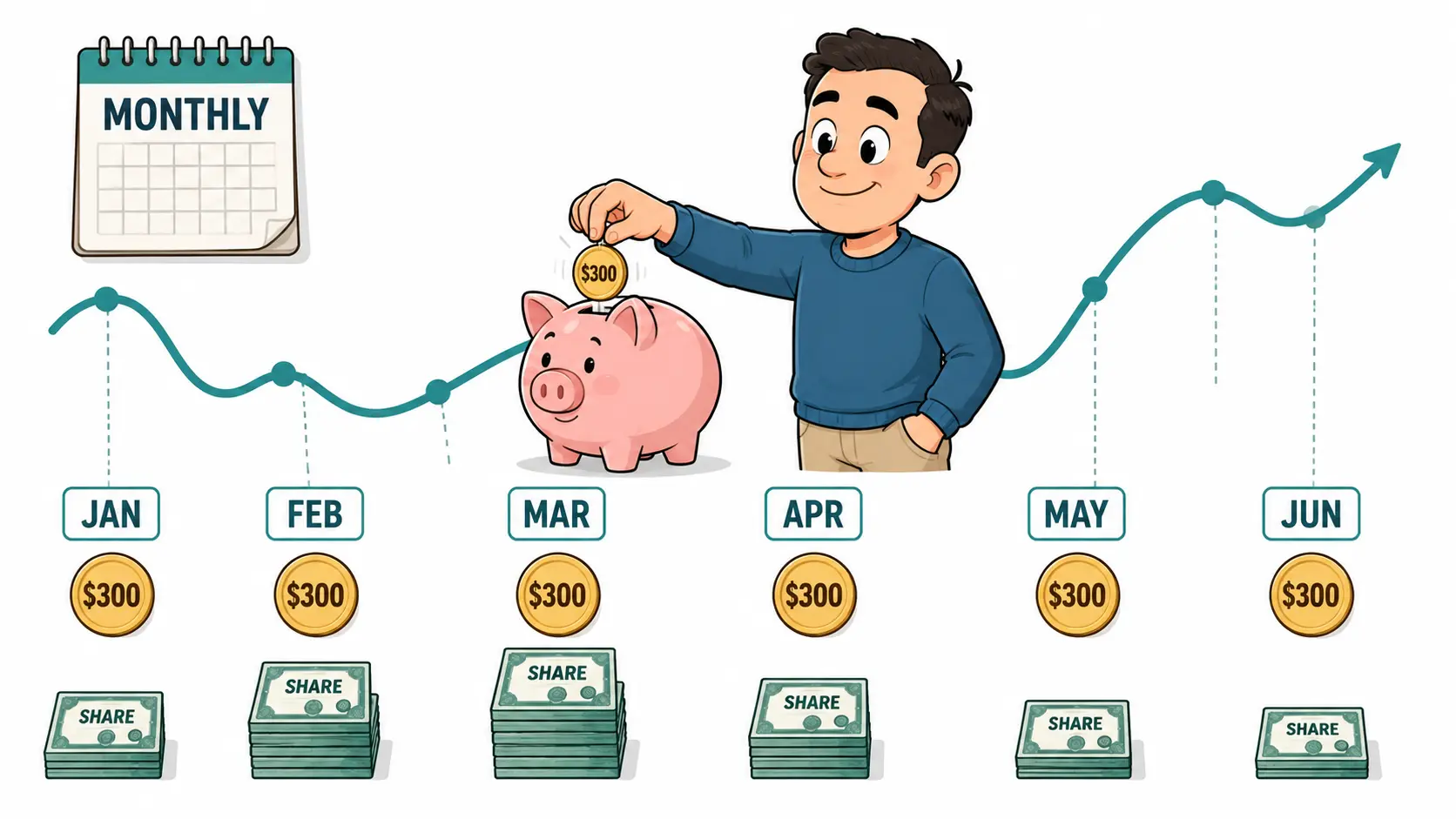
Example: You invest $300 per month into an ETF over 6 months.
| Month | Price per share | Shares purchased |
|---|---|---|
| Jan | $30.00 | 10.00 |
| Feb | $25.00 | 12.00 |
| Mar | $20.00 | 15.00 |
| Apr | $22.00 | 13.64 |
| May | $28.00 | 10.71 |
| Jun | $32.00 | 9.38 |
Total invested: $1,800. Total shares: 70.73. Your average cost per share: $25.45.
The average market price across those 6 months was $26.17. DCA delivered a lower average cost because you bought more shares during February and March when prices dipped. No analysis required, no charts to read.
This is the core math: fixed dollars divided by a fluctuating price always produces more shares at low prices and fewer at high prices. The result tilts your average cost downward.
By month 6 at $32, your $1,800 was worth $2,263: a 25.7% gain. A lump-sum buy of $1,800 at January's $30 would give you 60 shares worth $1,920: a 6.7% gain. The dip in months 2 through 4 let DCA accumulate extra shares cheaply.
DCA Scenarios Compared
| Dimension | Paycheck Investor | Windfall Deployer | Retiree Withdrawing |
|---|---|---|---|
| Situation | $500/month from salary | $100,000 inheritance | Drawing down portfolio |
| DCA fit | Only realistic option | Optional risk reducer | Not applicable |
| Alternative | None: no lump sum exists | Invest all at once | Systematic withdrawal plan |
| Biggest benefit | Builds habit, removes timing | Reduces regret if market drops | DCA not relevant here |
| Risk | Stopping during downturns | Cash drag while waiting | Sequence of returns risk |
| Best for | Anyone with regular income | Risk-averse investors | Different strategy entirely |
The table reveals a distinction most articles miss. For the paycheck investor, DCA is not a strategy choice: it is the default. The only decisions are how much to invest and how many stocks to own.
The windfall scenario is where the lump-sum debate applies. A two-thirds win rate for lump sum still means DCA wins roughly one in three times. For investors who would lose sleep deploying six figures on a single day, spreading the investment over 6 to 12 months is a reasonable compromise.
Where DCA Falls Short
DCA is not a guarantee. Three situations expose its limits.
Rising markets punish slow deployment. In a market that climbs steadily, every dollar held back buys shares at a higher price than the day before. Fidelity data since 1926 shows investing everything immediately outperformed DCA in about 64% of rolling periods. Over the last decade (dominated by a bull run), that figure rose to 79%. Cash on the sideline earns close to nothing while waiting.
DCA cannot fix a bad investment. Investing $300 per month into a stock heading toward bankruptcy buys more shares of a sinking ship. The strategy lowers your average cost, but lowering the cost of a worthless position still ends at zero. DCA works for broad market indexes and quality companies, not for blind picks.
Small accounts have more options than ever. Zero-commission brokers and fractional shares removed the fee barrier that once made DCA expensive. Today, investing small amounts costs nothing in transaction fees, making even weekly DCA practical.
DCA is a discipline tool, not a return booster. It keeps you invested through volatility. Over time, staying invested beats timing the market for most people.
See how fixed monthly investments compound over time with the dividend calculator: enter your amount, time horizon, and expected return.
Frequently Asked Questions
Can you use DCA with individual stocks or only ETFs? Both work. DCA into a broad ETF spreads risk across hundreds of companies. DCA into individual stocks concentrates your position over time, which amplifies gains if you pick well and losses if you pick poorly. Most investors use DCA with index funds or ETFs as a core, adding individual stocks only after doing the research.
How often should I invest with DCA: weekly or monthly? Monthly is the most practical frequency. Research shows minimal difference between weekly and monthly DCA over long periods. Match the frequency to your pay schedule. The habit matters more than the interval.
Does DCA work for crypto? The math is identical. Fixed amounts at regular intervals average out price volatility. Crypto's extreme swings mean DCA smooths the ride more than with stocks. The risk is asset-specific: DCA into a token that goes to zero still ends at zero.
Am I already doing DCA through my 401(k)? Yes. Every paycheck deduction going into your 401(k) is dollar-cost averaging. You invest a fixed amount per pay period regardless of market conditions. About 76% of 401(k) plans also auto-escalate contributions each year, increasing your DCA amount over time.