
Published
• 6 min read (EN)
What Is a DRIP: The Snowball Most Investors Ignore
A DRIP (dividend reinvestment plan) takes the cash dividends a stock pays you and automatically uses them to buy more shares of the same stock. Those extra shares earn their own dividends, which buy more shares, creating a compounding loop. Over decades, this loop turns modest yields into a major portion of total returns.
See how reinvested dividends compound with the dividend calculator: enter a starting amount, yield, and growth rate to watch the snowball effect year by year.
Why Reinvesting Dividends Matters
The numbers make the case. $10,000 invested in the S&P 500 in 1960 grew to roughly $1 million from price appreciation alone. With dividends reinvested, that same $10,000 became over $6.4 million. Hartford Funds research found that 84% of the S&P 500's total return since 1960 came from reinvested dividends and their compounding.
The annual return gap tells the same story in simpler terms. The S&P 500 averaged about 6.3% per year from price gains alone. With dividends reinvested, that figure rose to roughly 10.4%. That extra 4% compounding over decades is the difference between a comfortable nest egg and a much larger one.
Even during the "lost decade" of the 2000s, when stock prices delivered negative total returns, reinvested dividends still produced a positive 1.8% annualized return. Dividends turned a terrible decade into a merely disappointing one.
How a DRIP Works
When a company pays a quarterly dividend, your broker uses that cash to buy more shares at the market price on the payment date. If the payout is not enough for a whole share, you receive a fractional share. Every cent gets reinvested.
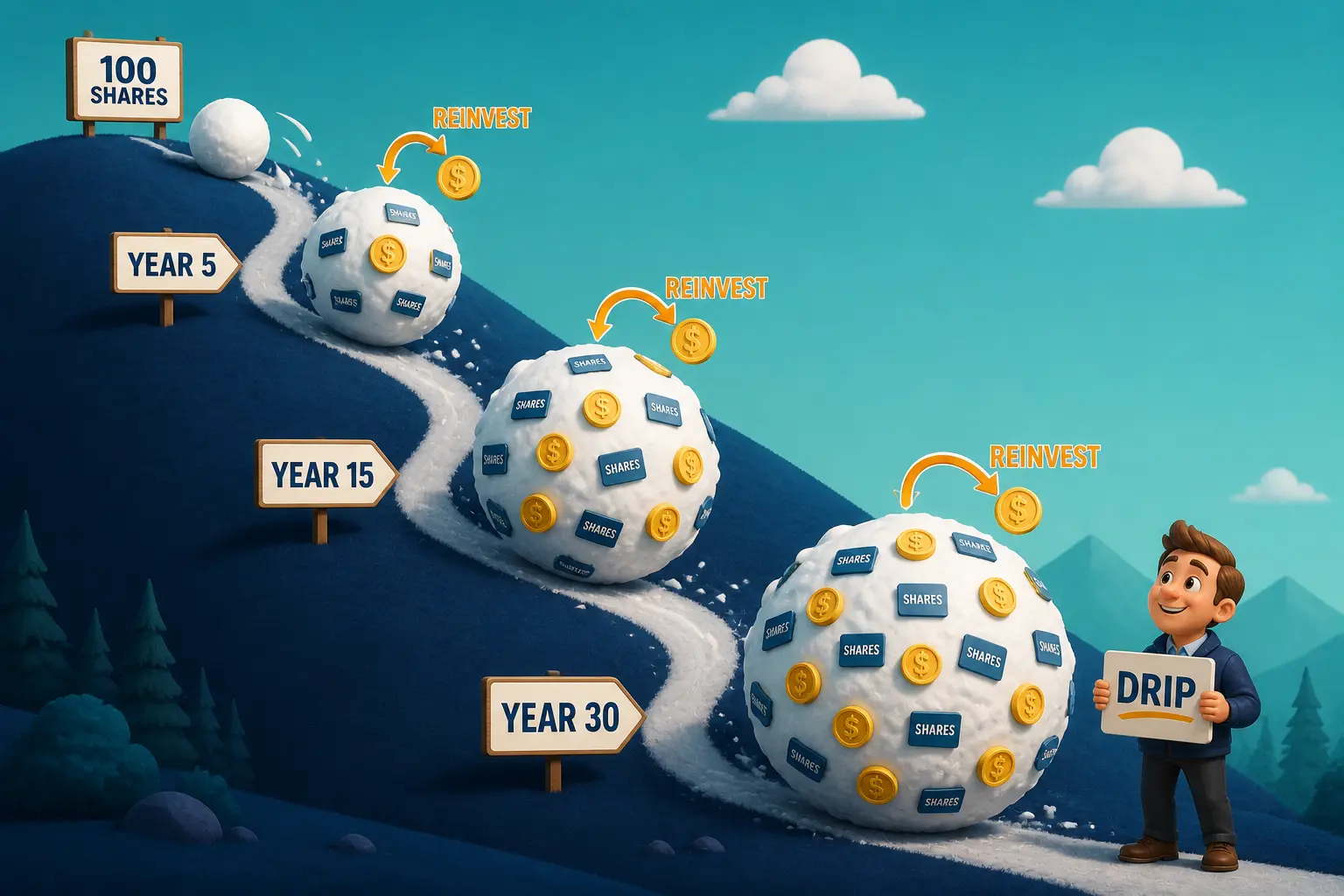
Example: You own 100 shares of a stock at $50 that pays a $0.75 quarterly dividend. Your payout is $75. At $50 per share, the DRIP buys 1.5 shares. Next quarter, you own 101.5 shares. The same $0.75 dividend now pays $76.13, buying 1.52 shares. Each quarter, the base grows.
Two types of plans exist. Broker DRIPs (offered by most major brokerages) cover any stock or ETF in your account and charge no fees. Toggle them on or off per holding. Company DRIPs are run directly by the issuing company and sometimes offer shares at a 1-5% discount to market price. Company plans are less flexible but that discount adds free return.
Accumulating ETFs offer a third path. These funds reinvest dividends internally, so payouts never reach your account. The effect is identical to a DRIP, but it happens inside the fund's net asset value: no setup, no separate tax event on each reinvestment in many jurisdictions.
DRIPs also create a built-in dollar-cost averaging effect. When the stock price drops, each dividend buys more shares. When it rises, each dividend buys fewer. This smooths your average purchase price over time without any action on your part.
DRIP Scenarios Compared
| Dimension | Young Accumulator | Mid-Career Builder | Retiree Needing Income |
|---|---|---|---|
| Goal | Maximize long-term growth | Balance growth and flexibility | Generate cash for expenses |
| DRIP fit | Ideal: decades of compounding | Strong: still time to compound | Poor: need cash, not shares |
| Tax consideration | Use tax-sheltered accounts | Mix of taxable and sheltered | Manage tax bracket with cash |
| Overconcentration | Low risk with broad ETFs | Monitor position sizes | High risk if too few holdings |
| Best approach | DRIP everything, forget it | DRIP in sheltered, review rest | Take cash, invest selectively |
The table highlights one key rule: DRIP works best when you do not need the income. Young investors with a 20-year horizon benefit most because compounding has time to work. A 3% yield reinvested for 25 years does not add 3% per year: it multiplies as each dividend growth cycle builds on a larger share count.
For investors who need income from regular dividend payments, taking cash makes more sense than reinvesting and then selling shares to cover expenses.
When to Take Cash Instead
DRIP is not always the right call. Four situations favor taking dividends as cash.
You need income for living expenses. Retirees drawing down their portfolio should take dividends as cash rather than reinvesting and selling shares to cover costs.
A position has grown too large. A stock that started at 5% of your portfolio can swell to 15% through DRIP combined with price gains. At that point, reinvesting adds concentration risk. Taking cash and redirecting it elsewhere restores balance.
The stock is overvalued. Automatic reinvestment buys at whatever the market price is on the payment date. If a stock has run far ahead of its earnings, you may prefer to deploy that cash into a cheaper opportunity. DRIPs offer no timing control.
Tax record-keeping is a burden. Each reinvestment creates a separate tax lot with its own cost basis. After 10 years of quarterly DRIP, one stock can have over 40 tax lots. In taxable accounts, this complicates capital gains calculations at sale. Reinvesting inside a tax-sheltered account avoids this problem because gains are deferred or exempt depending on the account type.
Model the difference between reinvesting and taking cash with the dividend calculator: toggle reinvestment on and off to see how the gap widens over time.
Frequently Asked Questions
Do you pay taxes on reinvested dividends? Yes. In most countries, reinvested dividends are taxed the same as cash dividends. Your tax authority does not care whether you took the money or reinvested it. Rates vary by jurisdiction and income level. To defer or avoid dividend tax, hold dividend stocks in a tax-sheltered account where your country offers one.
Can you turn off a DRIP at any time? Yes. Broker DRIPs can be toggled on or off per holding through your account settings, usually taking effect before the next dividend payment date. Company-direct DRIPs may require written notice to the transfer agent, which can take longer.
Is it better to DRIP individual stocks or ETFs? ETFs are the safer DRIP choice. Because an ETF holds dozens or hundreds of stocks, reinvesting its dividends maintains built-in diversification. DRIPing a single stock increases your concentration in that one company over time. If you DRIP individual stocks, monitor position sizes to avoid overexposure.
What happens to my DRIP if a company cuts its dividend? The DRIP continues with whatever amount the company pays. If the dividend is reduced by half, you reinvest half as much. If the dividend is eliminated entirely, the DRIP has nothing to reinvest and no shares are purchased. The plan does not protect you from dividend cuts.