
Updated
• 10 min read (EN)
ROIC vs WACC: The Value Creation Spread Explained
ROIC measures the return a company earns on the capital it has deployed. WACC measures what that capital costs to raise. The spread between the two decides whether each reinvested dollar makes shareholders richer or poorer. Anchor the cost side with our wacc calculator; the return side has to come from the 10-K or a clean data feed.
ROIC vs WACC at a Glance
ROIC is a performance metric. WACC is the hurdle to clear. The table pairs them on the dimensions that matter.
| Dimension | ROIC | WACC |
|---|---|---|
| Measures | Return earned on operating capital | Required return on the full capital base |
| Formula | NOPAT / Invested Capital | (E/V × Re) + (D/V × Rd × (1 − T)) |
| Inputs | Income statement + balance sheet | Market data, cost of debt, tax rate |
| Direction | Performance you score | Hurdle you must clear |
| Typical range | 6-30% by sector and capital intensity | 6-12% for most listed companies |
| Used in | Capital-allocation quality screens | DCF discount rate, hurdle rates |
| Best for | Judging operating efficiency | Judging cost of every funding dollar |
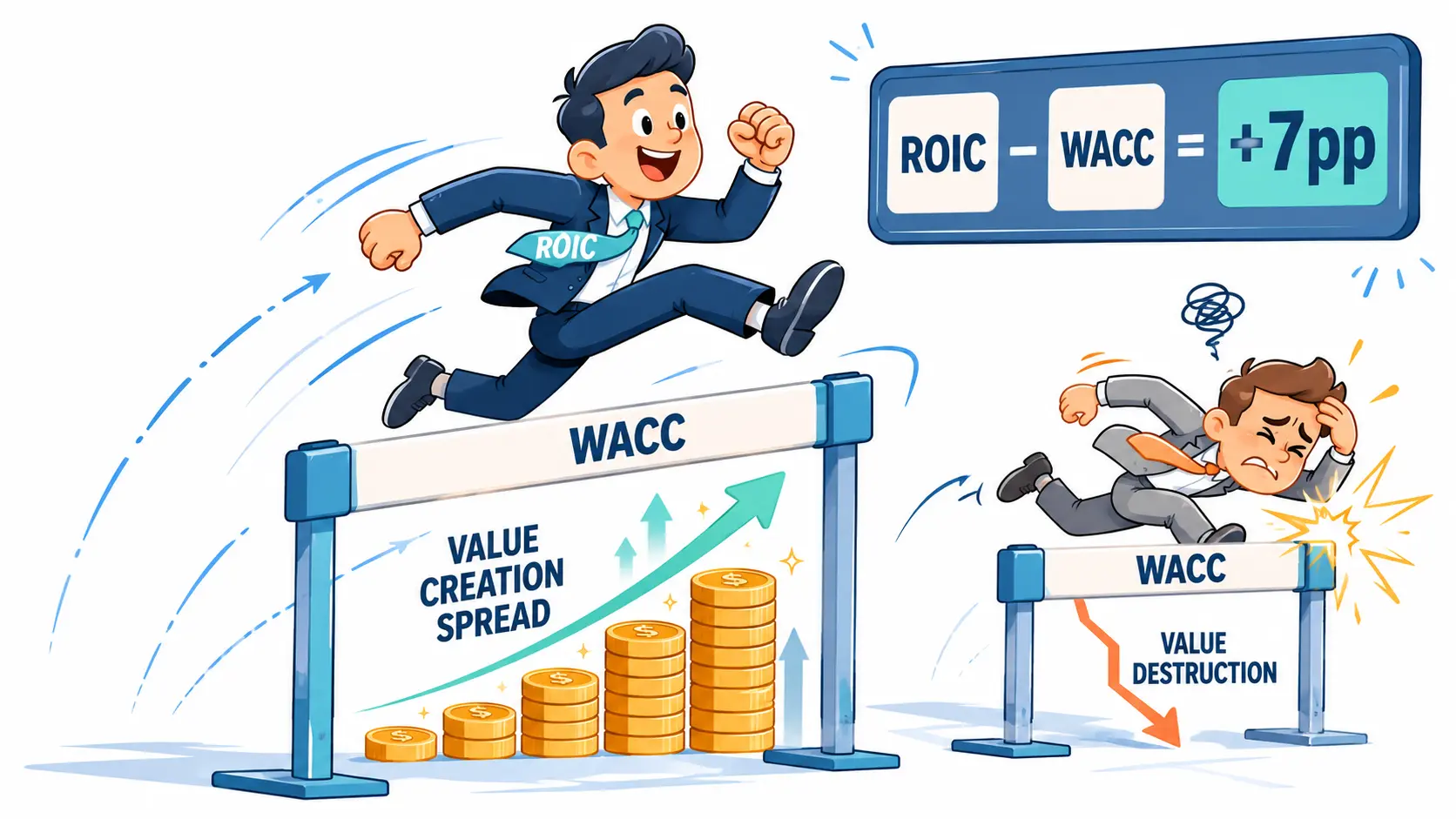
ROIC minus WACC is the figure that links them. Above zero, the business adds economic profit; below zero, growth destroys value.
What ROIC Tells You
ROIC divides Net Operating Profit After Tax (NOPAT) by invested capital. NOPAT equals operating income (EBIT) times one minus the tax rate, so interest expense never reaches the numerator. Invested capital is debt plus equity minus excess cash and non-operating assets, leaving the productive base. Financing decisions stop moving the ratio.
The metric asks: how much operating profit per dollar inside the business? Software companies often sit above 25%. Utilities and airlines land between 6% and 10%. Neither level is good or bad alone; both need WACC as the benchmark.
Limitation: Reported ROIC differs by provider. Treatment of operating leases, goodwill, and capitalized research and development varies, and figures for the same company can land 3 to 5 percentage points apart. Use one provider, or compute from the 10-K.
Example: A retailer reports $2 billion in NOPAT on $10 billion of invested capital, so ROIC equals 20%. A peer reports the same NOPAT on $20 billion because it owns its real estate outright. ROIC drops to 10%. The equity-only ROE metric misses this gap.
What WACC Tells You
WACC blends the cost of equity and after-tax cost of debt, weighted by how much of each the company uses:
E is the market value of equity, D the market value of debt, V equals E plus D, Re the cost of equity, Rd the pre-tax cost of debt, T the corporate tax rate. Equity is expensive because shareholders sit last in line. Interest on debt is tax-deductible, lowering the after-tax debt rate further.
WACC answers: what minimum return must the business deliver to keep lenders and shareholders whole? It is a hurdle, not a performance number. Lowering it requires cheaper debt, a lower equity premium, or a different mix.
Limitation: WACC is sensitive to assumptions. Risk-free rate, market risk premium, beta, and cost of debt each carry estimation error. Two analysts can produce WACCs 200 basis points apart for the same firm, and the gap flows straight into any discounted cash flow model.
Example: A firm with $800 million equity at 10% cost and $200 million debt at 5% cost, tax rate 21%, lands at WACC = (0.80 × 10%) + (0.20 × 5% × 0.79) = 8.79%. Move to a 50/50 mix and WACC drops to 6.98%. Same costs, different hurdle.
When to Use ROIC vs WACC
Each side carries a different decision: ROIC scores performance, WACC sets the hurdle, the spread links them.
| Scenario | What matters more | Why |
|---|---|---|
| Quality screen for compounders | ROIC level | High sustained returns point to durable advantage |
| DCF valuation | WACC | Discount rate is the biggest single lever in present value |
| Capital structure decisions | WACC | Comparing financing mixes is a cost-of-capital question |
| Cyclical businesses (multi-year) | Spread | Single-year ROIC swings hide the long-term value picture |
| Cross-industry comparison | Spread | A 12% ROIC utility can beat a 22% ROIC software firm net |
| Reinvestment story (capex-heavy) | Spread | Growth creates value only if new dollars earn above WACC |
Use ROIC when: screening for operating quality. Sustained ROIC above 15%, stable across a full cycle, marks a business that produces durable returns on what it already runs.
Use WACC when: building a valuation or evaluating a project, an acquisition, or a buyback. The number is a hurdle, so it sits on the cost side of every decision.
Use the spread when: assessing whether growth helps or hurts. A 7-point spread on $10 billion of invested capital adds $700 million of economic profit a year. At a −3 point spread, the same business destroys value every time it grows. The same logic separates capital deployed from assets held.
Using ROIC and WACC Together
Together they answer the question neither covers alone. Run both, subtract WACC from ROIC, multiply by invested capital. The result is economic profit, or the loss if the spread is negative. A retailer at 26% ROIC against 8% WACC has an 18-point spread; that gap is most of the moat story before a DCF confirms it. An operator at 8% ROIC and 8% WACC runs flat: covers its cost of capital, adds nothing. Growth in flat businesses is the most common form of value destruction in public markets, because each reinvested dollar earns only its own cost back.
Time horizon matters. One year above WACC means little. The reliable test is whether the spread holds for five years through one full cycle. Competition erodes excess returns, so most companies converge to WACC within a decade. A persistent spread is the strongest signal of a real moat. The top wide-moat list shows names where the spread has held for over a decade; the graham vs buffett comparison frames buying that spread cheaply versus paying up for sustained ROIC.
The pairing sits under most side-by-side reads in our stock metric comparisons guide: different ratios, same question about whether returns clear the cost of capital. Open the wacc calculator, subtract from the ROIC in the filings, and the gap turns growth into value or waste.
Frequently Asked Questions
What does it mean when ROIC is greater than WACC? It means the business earns more on the capital inside it than that capital costs to raise. Every reinvested dollar creates value for shareholders. A spread of 200 to 300 basis points is the entry-level bar; sustained spreads above 500 basis points point to a real competitive advantage.
Can a company grow if ROIC is below WACC? It can grow revenue and assets, but growth in that state destroys value. Each new dollar invested earns less than the dollar costs to raise, so shareholders end up poorer despite higher headline numbers. Either fix ROIC, return capital, or stop growing.
What is a good ROIC minus WACC spread? A positive spread of 300 basis points or more, held across a full business cycle, is the working threshold for a quality compounder. Some asset-light businesses sustain spreads of 10 to 20 percentage points. Banks and other financials use ROE versus cost of equity instead, since ROIC is hard to compute on their balance sheets.
Why is the spread more useful than ROIC alone? ROIC alone is not comparable across industries. A 12% ROIC is poor for software and excellent for a utility. Subtracting WACC normalizes the level: a utility at 12% ROIC and 7% WACC creates more value per dollar than a software firm at 18% ROIC and 14% WACC.